

 on Google


Tenant not paying rent: the landlord may claim the overdue rent and, as a rule, 20% compensation, give notice terminating the contract if the delay reaches three months (or if there are repeated delays) and, if the tenant does not leave, start the special eviction procedure at the Balcão do Arrendatário e do Senhorio (the official Tenant and Landlord Desk). This guide summarises the deadlines, how to communicate and what the law forbids you to do yourself.
In short
- ✓If the tenant catches up within the first eight days of delay, there is no room for compensation or for termination based on that delay (article 1041(2) of the Civil Code).
- ✓After eight days, the landlord may claim the overdue rent and compensation equal to 20% of what is due, unless they terminate the contract for non-payment (article 1041(1)).
- ✓If the delay reaches three months or more, or if there are delays of more than eight days more than four times in a year, the law treats keeping the contract as unreasonable and the landlord may terminate it by notice (articles 1083 and 1084).
- ✓Where there is a guarantor, notice of the delay must be given within 90 days after the end of the eight-day period (article 1041(5) and (6)).
- ✓If the tenant does not vacate, the legal route is the special eviction procedure at the Balcão do Arrendatário e do Senhorio, under article 15 of the Novo Regime do Arrendamento Urbano (New Urban Lease Regime, Law 6/2006; below, «NRAU»).
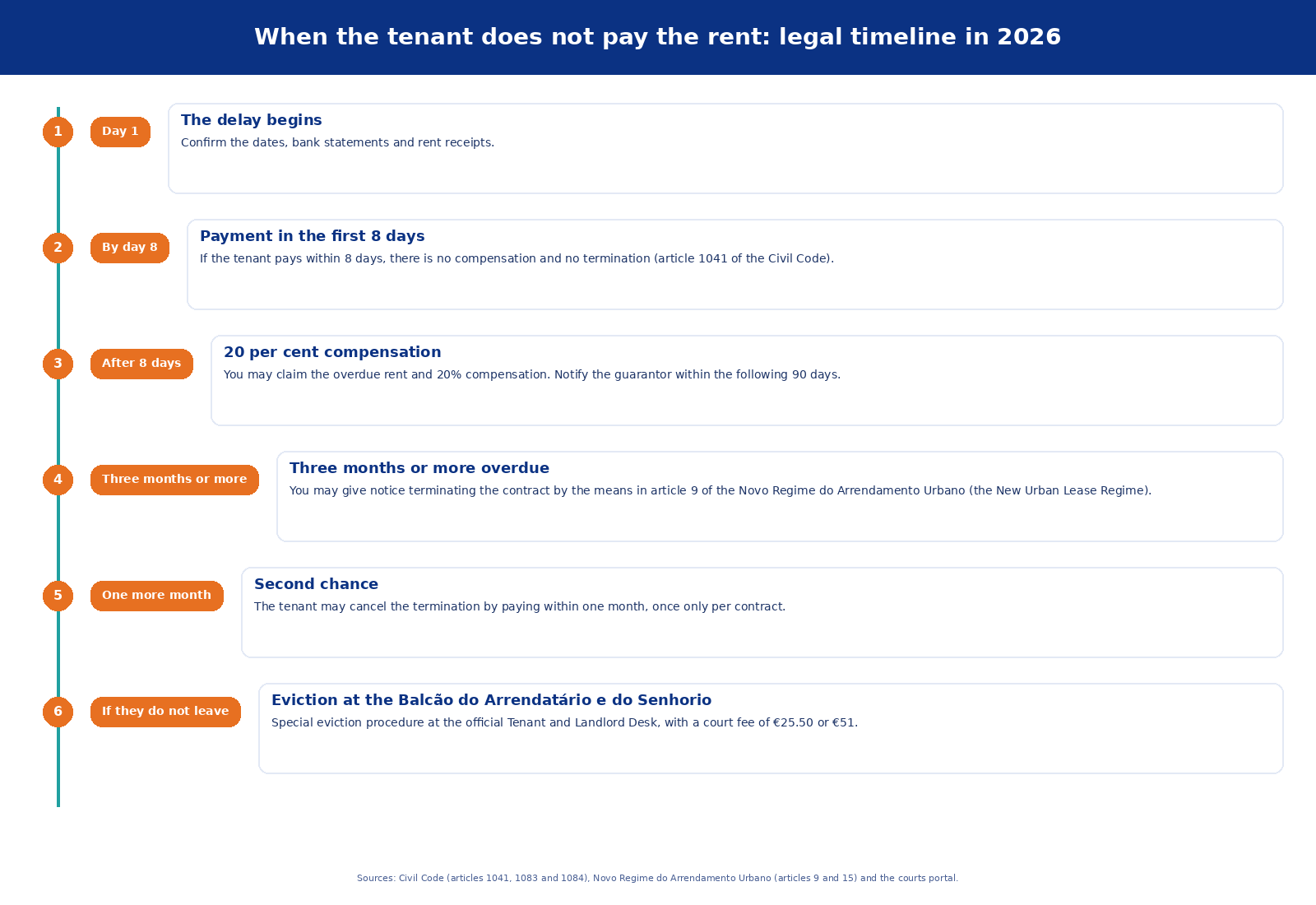
Legal timeline when the tenant does not pay the rent in 2026: eight days, 20% compensation, three months, second chance and eviction desk
1. Confirm the delay and get the figures right
Before any letter or formal request, confirm three things: the rent due date in the contract, the exact amount outstanding and the evidence (bank statement, receipts issued on the Portal das Finanças and the written contract itself). Without that record, you waste time arguing about numbers instead of moving forward.
Worked example
Imagine rent of €850, due on the 1st of each month. The tenant does not pay January, February or March.
| Situation | Value |
|---|---|
| Three rents overdue | €2,550 |
| 20% compensation (if you do not terminate for non-payment) | €510 |
| Total to claim to end the delay without termination | €3,060 |
If the landlord chooses to terminate the contract for non-payment, the 20% compensation in article 1041(1) does not stack with that termination. What the tenant must pay to cancel the termination, within one month, is the overdue rent and the compensation in article 1042(1) — the same 20% logic on what is due, now as a condition to end the delay after the termination notice.
If payment arrives within the first eight days counted from the start of the delay, that delay no longer supports compensation or termination. From the ninth day, the financial consequences apply clearly.
2. Ask for payment in writing (without confusing it with termination)
A written contact, with proof of content and of receipt, serves to demand regularisation and to create the paper trail that later supports collection. State the amount, the rents outstanding and a concrete deadline to pay — without mixing that demand with the termination notice, which has its own form.
Together with the contract, proof that you told the tenant the amount owed gives the landlord an enforceable title to collect rent, charges or expenses (article 14-A of the NRAU). You can use that route to enforce the debt without yet ending the contract. If the aim is to recover the property, termination and the special eviction procedure are separate steps.
Accepting later months’ rent does not wipe out the right to terminate the contract or to claim compensation for the instalments already late (article 1041(4)). Always leave in writing which month each payment relates to, so the debt stays clear.
3. Guarantor: the 90-day deadline many people miss
If there is a guarantor and the tenant does not end the delay within eight days, the landlord must, within the following 90 days, notify them of the delay and of the amounts owed. Only after that notice may the landlord demand payment from them (article 1041(5) and (6)).
This deadline is easy to forget when attention is only on the tenant. Keep proof of notice to the guarantor with the same care as the notice to the tenant.
4. Terminating the contract: three months or repeated delays
The law treats keeping the lease as unreasonable, among other situations, in these two non-payment scenarios:
«It is unreasonable for the landlord to keep the lease in the event of a delay equal to or greater than three months in the payment of rent, charges or expenses that fall on the tenant or of the tenant’s opposition to works ordered by a public authority, without prejudice to paragraphs 3 to 5 of the following article.»
— Civil Code, article 1083(3) (consolidated text; in force since 13 February 2019 in the version cited here)
There is also the repeated-delay regime: more than four times, consecutive or not, with a delay of more than eight days within one year, on the same contract (article 1083(4)). To use this ground, the landlord must have warned the tenant — after the third delay — by registered letter with acknowledgement of receipt, stating the intention to end the lease on that basis (paragraph 6). Here, paying in the month after the notice no longer cancels the termination.
Termination is effected by notice to the tenant invoking, with grounds, the obligation breached (article 1084(2)). The NRAU, in article 9(7), allows only certain means: separate formal service (notificação avulsa); personal delivery by a lawyer, solicitor or enforcement agent with a mandate; or, where the written contract fixes a domicile, a signed document sent by registered letter with acknowledgement of receipt. Outside that list, a registered sending without those requirements may be insufficient.
Watch the time-bar: the right to terminate must, as a rule, be exercised within three months of the moment the landlord learns of the ground, observing the rules for continuing or lasting facts (article 1085). If the counting is unclear, check with a lawyer before sending the notice.
5. The tenant’s second chance (and the vacation deadline)
When termination rests on a three-month delay and is done by notice, it ceases to take effect if the tenant catches up in the following month, paying what is due under article 1042. This second chance exists only once per contract (article 1084(3) and (4)).
As a rule, one month after termination the landlord may demand delivery of the property, unless the parties or the court have set a different deadline (article 1087). If the tenant stays, the next step is not to change the lock: it is the special eviction procedure at the Balcão do Arrendatário e do Senhorio.
6. If the tenant does not leave: eviction at the Balcão do Arrendatário e do Senhorio
This procedural route is used to make the end of the lease effective when the tenant remains in the property beyond the legal or agreed date (article 15 of the NRAU). It runs only at the Balcão do Arrendatário e do Senhorio, a service of the Directorate-General for the Administration of Justice, in electronic form and with nationwide coverage (official page of the procedure).
Practical conditions to keep in mind:
- A written contract is required, plus proof of stamp-duty payment (or that the rents have been declared for personal or corporate income tax, under article 15(5) of the NRAU).
- In the same application you may include overdue rent, provided the amount was previously indicated to the tenant (article 15(6)).
- According to information published on Tribunais.org.pt, the court fee is €25.50 if the value of the procedure is €30,000 or less, and €51 above that. The value of the procedure is two and a half years’ rent plus the rent outstanding.
- After being notified, the tenant generally has 15 days to leave, catch up or oppose. Opposition requires a lawyer; when termination rests on article 1083(3) or (4), opposition also generally requires paying a court fee and lodging a security capped at the equivalent of six rents — unless there is legal aid.
Total time varies with notification, any opposition, the court decision and actual vacation. There is no closed calendar in months that can be promised. There are situations of special tenant protection that may condition leaving; that topic will have its own article («Who cannot be evicted») and, in this guide, it is enough to remember that the landlord must not improvise outside the legal procedure.
7. What the landlord must never do
Changing the lock, cutting water or electricity, or seizing the tenant’s goods yourself is private justice. It can give rise to civil liability and, depending on the facts, also criminal liability. Recovery of the property goes through formal notice and, if needed, the special eviction procedure at the Balcão do Arrendatário e do Senhorio — never through physical pressure on the space.
8. Checklist with deadlines
- ✓Confirm dates, amounts and receipts on the Portal das Finanças.
- ✓In the first eight days: allow regularisation; if they pay, that instalment’s delay no longer supports compensation or termination.
- ✓After eight days: claim the rent and, if applicable, the 20% compensation; notify the guarantor within the following 90 days.
- ✓With a three-month delay (or under the repeated-delay regime, after the warning after the third delay): prepare the termination notice by the means allowed in article 9(7) of the NRAU.
- ✓Wait out the one-month second-chance period (only for a three-month delay and only once per contract).
- ✓If the tenant does not leave: file the application at the Balcão do Arrendatário e do Senhorio, with the contract, proof of the termination notice and the required tax evidence.
- ✓Keep recording rents that fall due during the procedure and fulfil any maintenance duties that are yours.
To prevent problems on the next contract, review the essential clauses of a tenancy agreement (in Portuguese) and the rules on property maintenance (in Portuguese). If there is damage to the let property, see also the guide on damage caused by tenants (in Portuguese).
9. And the 2026 rental reform?
In 2026 a reform of the letting rules has been under discussion, but as of October 2026 the Civil Code and NRAU articles referred to above still govern delay and eviction. Follow the state of the proposal in the article on the 2026 rental reform and the framework of the new rent law for existing contracts.
How Condoroo helps
In rental management, Condoroo tracks rent payments and alerts the owner to delays, with documented processes. Condoroo manages more than 600 condominiums in Portugal; in letting, the same rigour of records and deadlines reduces the risk of missing the guarantor deadline or sending a notice in the wrong form. This article is for information and does not replace legal advice.
Tenant not paying rent: frequently asked questions
How long before I can terminate the contract if the tenant does not pay the rent?
As soon as the delay in rent, charges or expenses reaches three months, or when in the same year there are more than four delays of more than eight days (and, in that second case, only after the warning given after the third delay).
Can I charge 20% on top of the overdue rent?
Yes, as a rule, when the tenant is in delay beyond eight days and the landlord does not terminate for non-payment. If you choose termination for non-payment, the compensation in article 1041(1) does not stack with that termination; payment to cancel the termination follows article 1042.
Can the tenant stop the eviction by paying?
On termination for a three-month delay, the tenant may still catch up in the month after the notice, once only per contract. If termination rests on repeated delays, that route is not available.
How is termination communicated to the tenant?
Article 9(7) of the Novo Regime do Arrendamento Urbano (New Urban Lease Regime) allows: separate formal service; personal delivery by a lawyer, solicitor or enforcement agent; or registered letter with acknowledgement of receipt when the written contract provides a domicile for that purpose.
When must I notify the guarantor?
Within 90 days after the end of the eight-day period in which the tenant could have ended the delay. Without that notice, you cannot demand payment from the guarantor.
Can I change the lock if the tenant does not pay?
No. Follow the legal route: termination notice and, if necessary, the special eviction procedure at the Balcão do Arrendatário e do Senhorio (the official Tenant and Landlord Desk).
How much does the special eviction procedure cost?
According to Tribunais.org.pt, €25.50 if the value of the procedure is €30,000 or less, and €51 above that (two and a half years’ rent plus rent outstanding), without prejudice to legal aid.