
 on Google


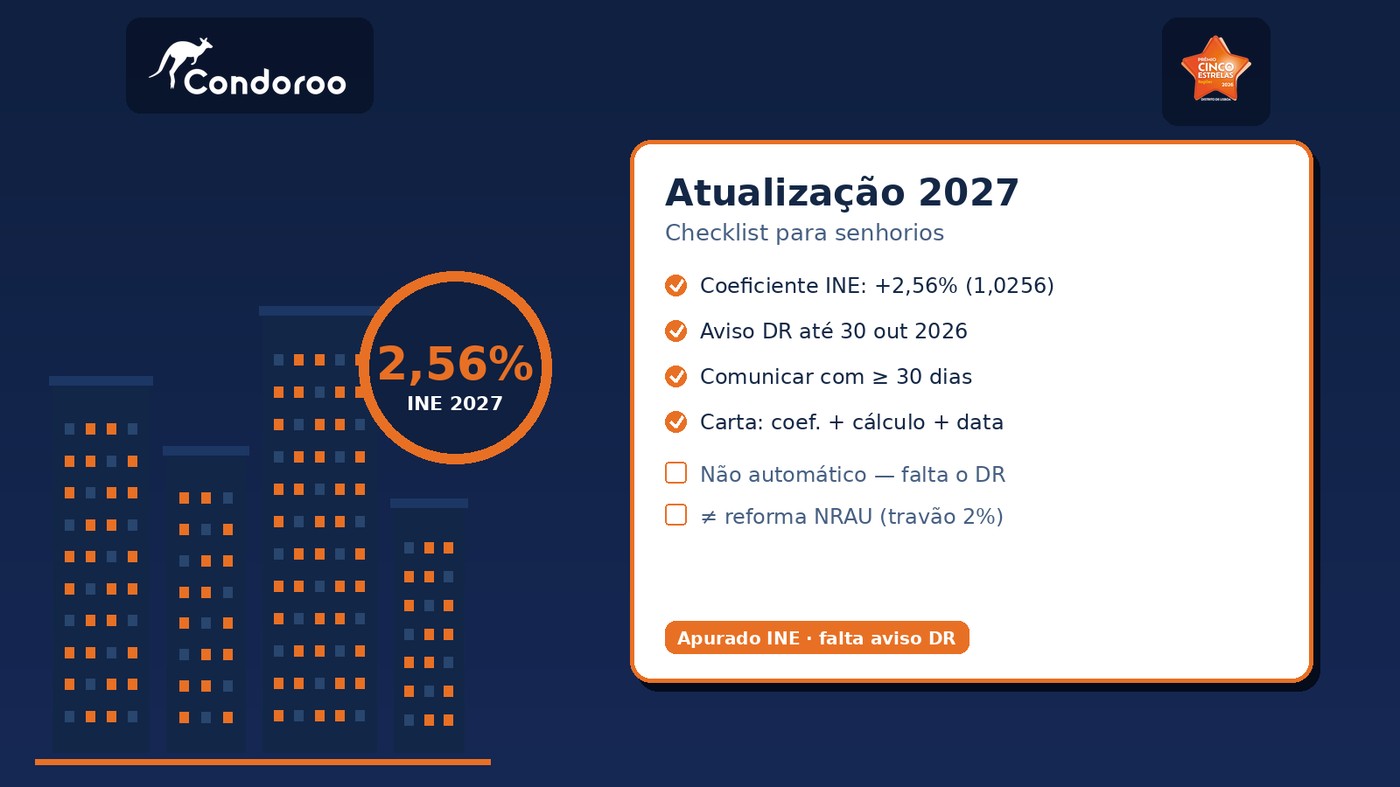
The coefficient for rent updates 2027 is 2.56% (factor 1.0256), according to Statistics Portugal (INE). It may only be applied after the notice in the Diário da República (expected by 30 October 2026); notice to the tenant requires at least 30 days in advance; it is not automatic. A practical guide for landlords — many with a unit in a condominium — covering the calendar, calculation, accumulation of missed coefficients and the letter checklist.
1. What INE confirmed (and what is still missing)
On 10 September 2026, Statistics Portugal (Instituto Nacional de Estatística) confirmed the average change in the consumer price index excluding housing over the 12 months to August: 2.56%. That figure underpins the annual rent-update coefficient for 2027 under the New Urban Lease Regime (NRAU). Sources such as Diário Imobiliário and coverage by idealista/news (which anticipated around 2.5% in August) align on this number.
Practical translation:
| Element | Situation (September 2026) |
|---|---|
| Figure confirmed by INE | +2.56% (coefficient 1.0256) |
| Notice in the Diário da República | Still pending — legal deadline by 30 October 2026 |
| Formal letter to the tenant | Only after publication in the DR |
| New rent takes effect | ≥ 30 days after notice (receipt by the tenant) |
| Comparison with 2026 | In 2026 the coefficient was 2.24% — a slight acceleration |
Until the notice appears in the DR, you may simulate the impact and prepare the draft letter. Do not send the formal letter with the 2027 coefficient before official publication: the document must cite the figure from the notice.
For the general framework on increase rules (deadlines, form of notice, limits), see also the Condoroo guide Increasing rent in Portugal — rules and limits.
2. Do not confuse: annual coefficient ≠ NRAU reform
In 2026 two distinct conversations about rents are circulating — and mixing them produces wrong letters and false expectations.
- Annual update of existing contracts — the subject of this article. It uses the INE coefficient published in the DR (in 2027: 2.56% once the notice is out). It applies to contracts subject to the legal update regime (or to a clause that points to that coefficient), with written notice and 30 days.
- NRAU / “Mais Habitação” reform — a legislative package under discussion that, among other measures, points toward ending the 2% cap on the initial rent of new contracts for properties with a recent letting history. That does not, by itself, replace or change the annual update coefficient for contracts already in force.
One-line summary: the 2% cap (when/if repealed) concerns new contracts; the 2.56% concerns the annual update of contracts in force. They are different engines. Condoroo has already published a checklist on the letting reform — here we only disambiguate so the wrong logic is not applied to the 2027 letter.
3. Concrete post-DR calendar (send → effective date examples)
The law (article 1077 of the Civil Code, under the legal regime) requires 30 days’ prior notice before the new rent takes effect. Practical guides such as Carta Registada recommend extra margin (around 35 days) to absorb CTT delivery time.
Assuming the 2027 coefficient notice appears in the DR by 30 October 2026, calendar examples (with sending margin):
| Intended new rent date | Send the letter (order of magnitude) |
|---|---|
| 1 January 2027 | by late November 2026 (e.g. ~28 Nov) |
| 1 March 2027 | by late January 2027 |
| 1 June 2027 | by late April 2027 |
| 1 September 2027 | by late July 2027 |
Important notes:
- The 30-day count runs, as a rule, from receipt of the notice by the tenant — not from the landlord’s postmark date.
- The 2027 coefficient does not oblige an update in January: it may be applied throughout 2027 (and, under the 3-year rule, even later — see section 5), provided the contract already allows an update and the notice is in order.
- Contracts with less than one year of duration: under the legal regime, the first update only after one year from the start of the contract (e.g. contract from March 2026 → first update possible from March 2027, with prior notice).
4. How to calculate: rent × 1.0256
Base formula (when only the 2027 coefficient applies):
New rent = current rent × 1.0256
Examples:
| Current rent | Increase (+2.56%) | New rent |
|---|---|---|
| €500 | €12.80 | €512.80 |
| €750 | €19.20 | €769.20 |
| €1,000 | €25.60 | €1,025.60 |
| €1,250 | €32.00 | €1,282.00 |
On a rent of €1,000, the monthly increase of €25.60 equals €307.20 a year — if the update only starts mid-year, the 2027 impact is proportional to the months in which the new rent applies.
If the contract has its own update clause (different indexation, Euribor, fixed percentage, tenant turnover in commercial leases, etc.), that clause prevails over the legal coefficient. Only in the absence of a specific written agreement does the legal regime apply (DR coefficient + 30 days). Always check the contract wording before multiplying.
5. The 3-year rule: accumulating missed coefficients
An update is not an obligation — it is a landlord’s right. If you did not update in previous years, as a rule you may recover missed coefficients in a single communication, provided each coefficient is still within the three-year window counting from the year to which it relates.
In practice, in 2027, a single letter can usually include (if not yet applied and if the contract allows) the coefficients applicable to 2025, 2026 and 2027 — earlier ones will already have expired. Recent reference values (official or confirmed):
| Year | Coefficient | Change |
|---|---|---|
| 2027 | 1.0256 | +2.56% (confirmed; DR notice still pending) |
| 2026 | 1.0224 | +2.24% |
| 2025 | 1.0216 | +2.16% |
| 2024 | 1.0694 | +6.94% |
How to accumulate: multiply in sequence. Example (€1,000 rent, no updates in 2025–2027):
1,000 × 1.0216 × 1.0224 × 1.0256 ≈ €1,070.90 (order of magnitude; round carefully and show the calculation in the letter).
Do not invent percentages “by eye”: use the official coefficients (or the DR notice figure for 2027) and show the arithmetic. If only one year was missed, apply only that one.
6. Checklist: what the letter must include
Communication must be in writing, preferably by registered letter with acknowledgement of receipt (or hand delivery with a signed copy). According to established practice and guides such as Improxy, the letter should make clear:
- Identification of the landlord, the tenant and the property / contract.
- Coefficient(s) applied and reference to the Diário da República notice (number/date, once published).
- Transparent calculation: previous rent × coefficient(s) = new rent.
- New amount of the monthly rent, in euros.
- Effective date (respecting ≥ 30 days after receipt).
- If accumulating missed years: list of coefficients and the order of multiplication.
- Signature and a means that allows proof of receipt.
Before sending:
- [ ] Has the 2027 coefficient notice already appeared in the DR?
- [ ] Contract with ≥ 1 year (first update) / 1-year interval since the last?
- [ ] Own contractual clause? If so, apply that — not the “default” coefficient.
- [ ] Residential or commercial with specific rules/clauses?
- [ ] Older leases / special regimes: confirm whether there are limits or separate procedures.
- [ ] Does the draft review coefficient, calculation, new rent and date?
- [ ] Sending margin (≥ 30–35 days)?
Until the DR, prepare simulations and the draft; do not fire off the 2027 letter “already”.
7. Residential, commercial and older leases
Residential (legal regime): DR coefficient + 30 days’ notice + annual interval / first-year rules, unless a different clause applies.
Commercial (shops, offices, warehouses): may also be updated by the legal coefficient if the contract does not provide another formula. Many commercial contracts have their own indexation — read the clause before using 1.0256.
Older leases / special regimes: their own protections and thresholds (including legislation that kept safeguards on older residential contracts) do not, by themselves, prevent an annual update when it is legally allowed — but they may condition amounts, transitions or formalities. If in doubt, confirm the framework of the specific contract (and, if needed, legal advice) before sending the letter.
8. Condo angle: fees and insurance in the same cycle
Many landlords do not manage only the rent: they hold a unit in a condominium. The autumn/winter cycle in which rent updates 2027 are prepared is the same cycle in which:
- the assembly discusses the budget and condo fees for the following year;
- the building’s multi-risk insurance (and, where applicable, the unit’s) is reviewed or renewed;
- maintenance and reserves face inflationary pressure similar to the CPI that feeds the rent coefficient.
Raising the rent without looking at condo fees and insurance leaves net yield shaky: the +2.56% on rent may be partly absorbed by common charges. Good practice for the landlord-owner is to treat the package together:
- Simulate the new rent (1.0256) and the expected impact of fees/insurance.
- Keep receipts and minutes — proof of charges and sound management of the unit.
- Use tools that centralise condo accounts and documentation (Condoroo helps owners and administrations keep the digital history organised), so the rent letter and the assembly do not live in separate folders.
We do not name competing condominium-management software: the point is the financial cycle, not the catalogue.
9. FAQ — rent updates 2027
What is the rent update coefficient for 2027?
2.56% (factor 1.0256), confirmed by INE on 10 September 2026 based on CPI excluding housing. The official notice in the Diário da República should appear by 30 October 2026.
Can I already send the update letter for 2027?
You may prepare the draft and the figures. The formal letter should only go after publication of the notice in the DR, stating the official coefficient.
How much notice must I give the tenant?
At least 30 days before the new rent takes effect (art. 1077 of the Civil Code, legal regime). Count from receipt and leave postal margin.
Can I accumulate coefficients from years when I did not update?
Yes, as a rule, within the three-year window of each coefficient. In 2027, typically 2025 + 2026 + 2027, if not yet applied and the contract allows. Multiply in sequence and show the calculation.
Is this the same as ending the 2% cap in the NRAU reform?
No. The 2.56% coefficient updates contracts in force. The 2% cap (under discussion in the reform) mainly concerns the initial rent of new contracts. Do not mix the two rules in the same letter.
What if the contract has its own update clause?
The contractual clause prevails over the legal coefficient. Only in the absence of a specific written agreement does the DR regime apply.
Do commercial contracts also use 2.56%?
They may, if the contract has no formula of its own. Many commercial leases index differently — check the clause.
The contract is less than one year old. Can I update?
Under the legal regime, the first update only after one year of duration. Afterwards, respect the annual interval and the 30-day notice.
Conclusion
Rent updates 2027 rest on a clear number — 2.56% / 1.0256 — but execution is procedural: DR notice, letter with coefficient, calculation, new rent and date, ≥ 30 days’ notice, and attention to clauses, accumulation of missed years and special regimes. It is not automatic; it is not the NRAU reform; and for anyone with a condo unit, it pays to align rent, fees and insurance in the same cycle. Prepare now; send only after the Diário da República.
Note: this article is general information, not legal advice. Always confirm the contract, the official DR notice and, in doubtful cases, professional support.
Frequently asked questions
What is the rent update coefficient for 2027?
2.56% (factor 1.0256), confirmed by INE on 10 September 2026 based on CPI excluding housing. The official notice in the Diário da República should appear by 30 October 2026.
Can I already send the update letter for 2027?
You may prepare the draft and the figures. The formal letter should only go after publication of the notice in the DR, stating the official coefficient.
How much notice must I give the tenant?
At least 30 days before the new rent takes effect (art. 1077 of the Civil Code, legal regime). Count from receipt and leave postal margin.
Can I accumulate coefficients from years when I did not update?
Yes, as a rule, within the three-year window of each coefficient. In 2027, typically 2025 + 2026 + 2027, if not yet applied and the contract allows. Multiply in sequence and show the calculation.
Is this the same as ending the 2% cap in the NRAU reform?
No. The 2.56% coefficient updates contracts in force. The 2% cap (under discussion in the reform) mainly concerns the initial rent of new contracts. Do not mix the two rules in the same letter.
What if the contract has its own update clause?
The contractual clause prevails over the legal coefficient. Only in the absence of a specific written agreement does the DR regime apply.
Do commercial contracts also use 2.56%?
They may, if the contract has no formula of its own. Many commercial leases index differently — check the clause.
The contract is less than one year old. Can I update?
Under the legal regime, the first update only after one year of duration. Afterwards, respect the annual interval and the 30-day notice.

We are transforming condominium and rental management in Portugal. Our mission is to make the owner experience easy and efficient, through experienced managers and our platform.
Contactos
sales@condoroo.ai
Telemóvel
+351 911 194 727
Sede
Rua Castilho 14C 5º Lisboa