
 on Google


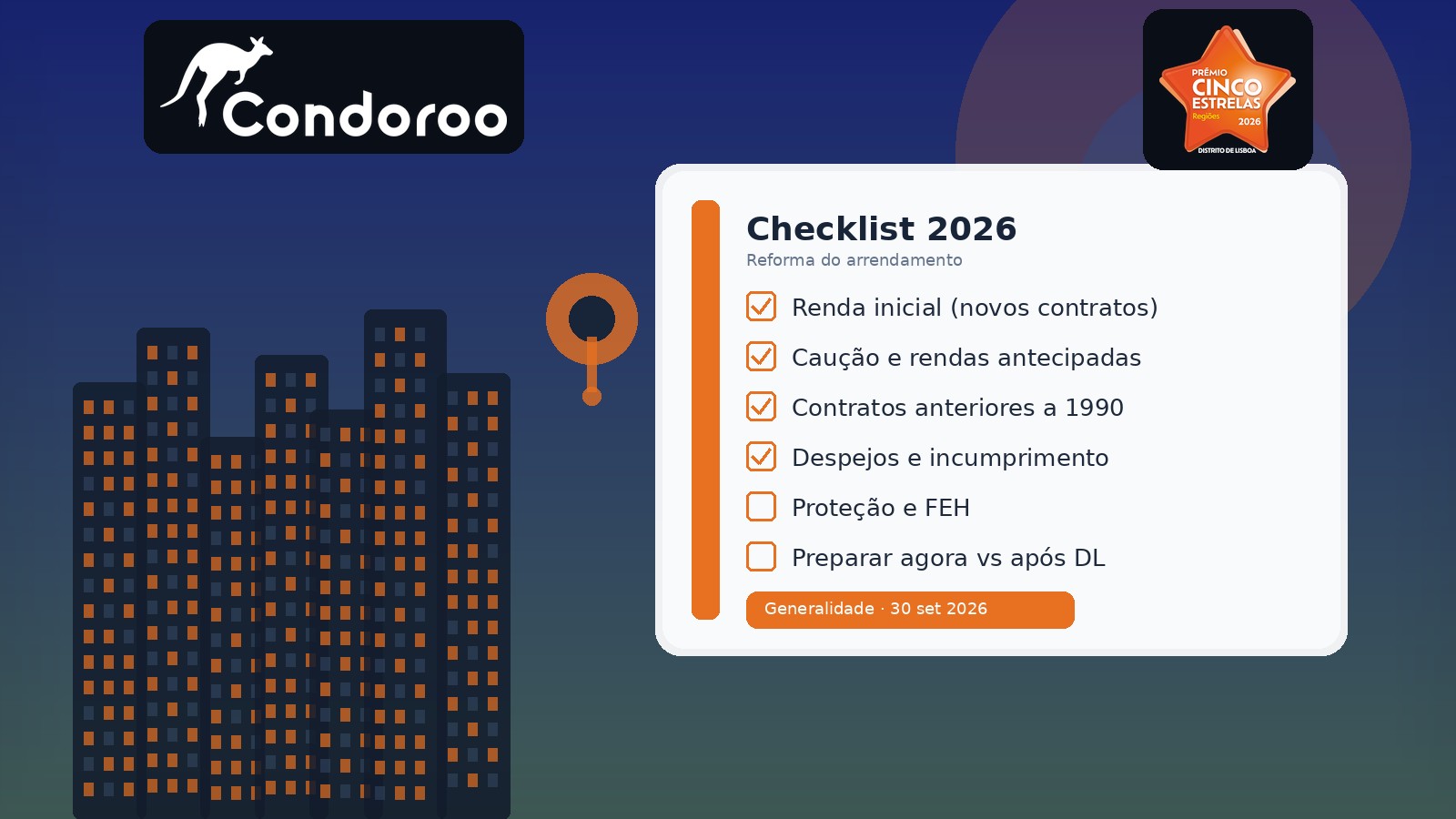
Portugal’s rental reform has passed its first vote in Parliament, but it is not yet law. On 30 September 2026, the Assembleia da República approved in general terms Bill 103/XVII (Proposta de Lei), which authorises the Government to amend the urban lease regime by decree-law. Until the decree-law is published, the golden rule is simple: contracts must continue to comply with the current law. This checklist separates what the bill proposes from what already applies today, so that landlords and tenants know what to do now.
In short
- ✓The bill was approved in general terms; the detailed reading, the final vote and the decree-law are still to come.
- ✓Until then, the deposit is still limited to two months’ rent and rent paid in advance to two months.
- ✓The bill reduces to two months the arrears that allow the contract to be terminated.
- ✓Rent updates in 2027 follow the official coefficient of 2.56%.
- ✓Organise contracts, receipts and correspondence now: it helps in any scenario.
1. What stage the bill is at
Bill 103/XVII is a legislative authorisation: if it is approved, the Government is authorised to approve a decree-law, whose draft accompanies the bill. The authorisation lasts 180 days (article 3 of the bill). At the general vote, PSD and Chega announced an agreement to amend the text at the detailed stage, including limits on deposits and rent paid in advance, according to RTP.
In October, the process slowed down. ECO reported Chega’s threat to break the agreement, and idealista described the law as being «on stand-by». On 21 October, PSD said it trusted the agreement, according to ECO. The text may therefore change, or may not be approved at all.
2. What remains in force today
Until the decree-law is published in the Diário da República, the current rules of the Civil Code apply. The most quoted concerns money paid up front:
«1 – O pagamento da renda pode ser antecipado, havendo acordo escrito, por período não superior a dois meses. 2 – As partes podem caucionar, por qualquer das formas legalmente previstas, o cumprimento das obrigações respetivas, até ao valor correspondente a duas rendas.» — Civil Code, article 1076
In plain English: rent can be paid in advance, by written agreement, for no more than two months; and the parties can secure their obligations with a deposit or other guarantee worth up to two months’ rent.
A deposit of three months’ rent asked for today «because the law is going to change» still breaks the law. The same applies to clauses that anticipate rules not yet published.
3. What the bill changes: summary table
| Topic | Current law | Draft decree-law |
|---|---|---|
| Rent paid in advance | Up to 2 months, with written agreement | Up to 3 months, with written agreement |
| Deposit | Up to 2 months’ rent | No legal limit |
| Initial rent in homes already let | 2% cap (art. 34 of Law 56/2023) | Cap repealed |
| Termination for non-payment | Arrears of 3 months or more | 2 months |
| Repeated delays of more than 8 days | More than 4 times in 12 months | More than 3 in 12 months or more than 4 in 18 |
| Automatic renewal | Same period, or 3 years if shorter | Same period, unless agreed otherwise |
| Ending an open-ended contract | 5 years’ notice | 3 years’ notice |

Sources: Civil Code, Law 56/2023 and the draft annexed to the bill.
4. Checklist for landlords
- ✓Do not rewrite existing contracts on the basis of the bill. A change is only valid with the agreement of both parties.
- ✓In new contracts, respect the limit of two months’ deposit and two months’ rent in advance.
- ✓Separate on the receipt the month’s rent, any rent in advance and the deposit.
- ✓Record delays with dates. Today, termination for repeated delays requires a registered letter with acknowledgement of receipt after the third delay (article 1083(6)).
- ✓Update the rent in 2027 with the 2.56% coefficient, giving written notice 30 days in advance.
- ✓Keep the property’s history: previous contracts, works and the energy certificate.
For details of what would change in contracts already signed, see our guide to the new rent law and existing contracts.
5. Checklist for tenants
- ✓Read the whole contract before paying a deposit or rent in advance.
- ✓Refuse requests above the current limits: two months’ deposit and two months in advance.
- ✓Make an inventory with dated photos at the start of the contract.
- ✓Pay by bank transfer and keep the receipts.
- ✓Negotiate in writing any payment plan for rent arrears.
- ✓Check the IRS deduction for rent: 15% of the rent on your permanent home, up to the limit in article 78-E of the IRS Code.
6. Evictions and non-payment
Today, the law considers that the landlord does not have to keep the contract when arrears reach three months:
«3 – É inexigível ao senhorio a manutenção do arrendamento em caso de mora igual ou superior a três meses no pagamento da renda, encargos ou despesas que corram por conta do arrendatário ou de oposição por este à realização de obra ordenada por autoridade pública, sem prejuízo do disposto nos n.os 3 a 5 do artigo seguinte.» — Civil Code, article 1083(3)
In plain English: the landlord cannot be required to keep the lease if the tenant is three months or more behind with rent, charges or expenses, or opposes works ordered by a public authority.
The tenant can still stop the termination by paying the debt within one month (article 1084(3)). The bill lowers the threshold to two months and allows communications by email when the parties agree. The special eviction procedure continues to run through the Tenant and Landlord Office (BAS). None of these changes allows evictions without a decision: changing the locks or cutting off the water is still illegal.
7. Old contracts and support for vulnerable families
The Government’s statement also mentions moving contracts signed before 1990 to the current regime and creating a Housing Emergency Fund. These measures depend on the final text and on regulations. Anyone with an old contract should keep proof of the household’s income and age and wait for the published version before making decisions.
8. The market while the law is pending
Uncertainty also weighs on prices. For landlords, the rent should reflect real demand in the area, not a law that may still change. For tenants, comparing listings helps, but the rent that counts is the one in the contract. Both sides gain from a clear contract, a signed inventory and itemised receipts. See also our guides to rental management and short-term or long-term rentals in Lisbon.
What if the building is under horizontal property?
The reform does not change condominium rules. Condominium charges are still owed by the owner of the unit, not by the tenant, and the condominium regulations still bind whoever lives there. Breaching those regulations can justify the landlord terminating the contract (article 1083(2)(a) of the Civil Code). It is a good idea to give the tenant the condominium regulations with the contract.
How Condoroo helps
Condoroo manages more than 600 condominiums, with a team of more than 20 professionals, and follows the legal changes that affect owners and tenants. We have professional liability insurance of €500,000 and have held the DECO seal for the third year in a row. Each building’s bank account is in the condominium’s name.
Rental reform in Portugal: frequently asked questions
Is the rental reform already in force?
No. The bill was approved in general terms on 30 September 2026. The detailed reading, the final vote and the publication of the decree-law are still to come.
Can I already ask for a deposit of three months' rent?
No. Until the new law comes into force, the deposit is limited to two months’ rent (article 1076(2) of the Civil Code).
How much can rents rise in 2027?
The update coefficient for 2027 is 2.56%. The landlord must give written notice of the increase 30 days in advance.
Does the bill apply to contracts I already have?
The draft provides for it to apply to existing leases too. The final text may change at the detailed stage.
How many months of arrears allow the contract to be terminated?
Today, three months. The bill reduces this to two months, but only once the decree-law is published.
Where does the special eviction procedure run?
At the Tenant and Landlord Office (Balcão do Arrendatário e do Senhorio, BAS), electronically.
This article is for information only. Legislation and websites checked on 26 October 2026.