
 on Google




Yes — the minutes that set the annual amount payable by each co-owner and the due dates constitute an enforceable title (art. 6 of DL 268/94); the administrator must act within 90 days if the debt is the IAS, unless the assembly resolves otherwise. This operational guide for syndics, administrators and co-owners explains when the minutes allow enforcement without a prior declaratory action, the minimum checklist, the difference between constitutive and recognitive minutes, the 2026 IAS threshold (537.13 €) and the mistakes that invalidate recovery. Use this assembly minutes enforceable title checklist to act in time.
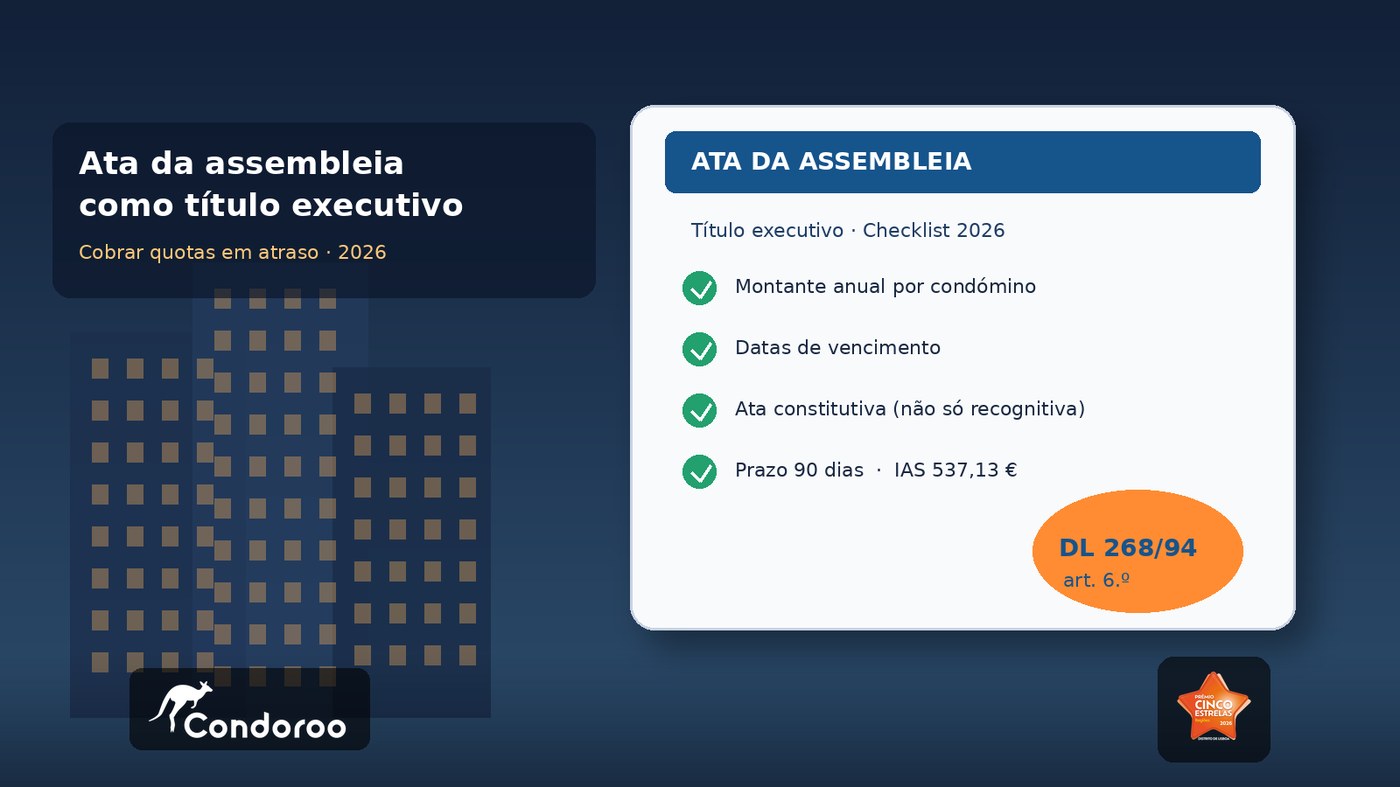
Key points from this article
1. Why the minutes matter more than the letter in the letterbox
Overdue condo fees drain the reserve fund, delay works and strain the assembly. Many condominiums respond with successive notices for years — and only later discover that the oldest debt has already prescribed. Portuguese law, since Decree-Law no. 268/94, gives the condominium a different tool: when the minutes meet the legal requirements, the administrator can proceed straight to enforcement proceedings, without a declaratory action that first proves the credit exists.
In August 2026, idealista/news again explained this mechanism on the basis of art. 6 of DL 268/94 and recent case law of the Lisbon Court of Appeal (Tribunal da Relação de Lisboa). The practical point is simple: the decisive document is the annual budget minutes — those that set the amount per unit and the due dates — not the minutes that, months later, merely “recognise” that someone owes money.
This article connects that framework with the duty to act within 90 days (Law no. 8/2022), the 2026 IAS threshold and the most common mistakes that cause recovery to fail. For the broader context of debts and prevention, see also the Condoroo guides on condo debts and co-owners who do not pay condo fees.
2. What an enforceable title is (and what the minutes dispense with)
An enforceable title (título executivo) is the document the law recognises as sufficient to bring enforcement proceedings and obtain the credit judicially, without a prior recognition stage. In condominium terms: with the right minutes, you do not need a long process merely for the court to declare that the debt exists — you move straight into coercive recovery.
Art. 6(2) of DL 268/94 (as amended by Law no. 8/2022) is express: the assembly minutes that meet the requirements of paragraph 1 constitute an enforceable title against the owner who fails to pay their share within the established deadline. Paragraph 3 includes in the title default interest at the legal rate and pecuniary sanctions approved by the assembly or provided for in the regulations.
In practice, this saves months and costs. But it only works if the minutes are properly drafted — and if they are the right type.
3. Minimum checklist: what the minutes must contain
Art. 6(1) requires that the minutes have resolved the amount of contributions to be paid, stating:
- The annual amount payable by each co-owner — the building’s global budget alone is not enough;
- The due date of the respective obligations — the date on which each instalment becomes payable.
Without either of these two elements, the minutes cease to serve as an enforceable title. It is the most frequent mistake: the budget and accounts are approved, but nothing is written about how much each unit owes or when it falls due.
Operational checklist (before filing the minutes)
- Identifies the assembly, date, place and those present/absent;
- Expressly resolves the annual amount per co-owner / unit (or an annexed table with the same effect);
- States the due date (or dates) of the instalments;
- Refers to interest and sanctions if they have been approved;
- Was read/approved under the legal terms and communicated to absentees;
- Is stored with annexes (fees schedule, budget) in a recoverable form.
Practical note: the fees schedule per unit should be treated as an integral part of the resolution. If there is only an “approved total budget” without allocation per co-owner, expect the declaratory route — slower and more expensive.
4. Constitutive vs recognitive minutes (TRL 20.11.2025)
Not every set of minutes “about debts” counts as a title. A distinction is needed:
| Type | What it does | Serves as enforceable title? |
|---|---|---|
| Constitutive minutes | Sets the fees/contributions to be paid (an obligation that will fall due) | Yes, if it meets amount per co-owner + due date |
| Recognitive minutes | Merely recognises past debts / lists defaults | As a rule, no |
Law no. 8/2022 reinforced this reading: in art. 6 it replaced the expression “amount of contributions due” with “amount of contributions to be paid”. The ruling of the Lisbon Court of Appeal of 20 November 2025 (case no. 29136/23.8T8LSB-B.L1-6), cited by Idealista, states that only the constitutive minutes of the payment obligation may be considered an enforceable title, not the recognitive minutes of a debt, adding that “contributions to be paid” are those that will fall due in the future.
Example: in February the assembly approves the annual budget, each unit’s monthly fee and the due day — those minutes are the title. If, in September, the assembly merely “recognises” that co-owner X owes March to August, that second set of minutes, by itself, does not replace the first.
5. The 90 days and the 2026 IAS threshold (537.13 €)
Since Law no. 8/2022, art. 6(5) of DL 268/94 imposes a clear duty: the administrator must bring the recovery action within 90 days of the date of the co-owner’s first default, provided that the amount owed is equal to or greater than the Social Support Index (IAS) for the relevant calendar year — unless the assembly resolves otherwise.
In 2026, the IAS is set at 537.13 € (Ordinance no. 480-A/2025/1). Below that threshold, the legal duty to bring the action within 90 days is not automatically triggered; from that level upwards, it is — unless the assembly adopts another criterion.
An administrator who lets fees prescribe through inaction may be liable within the scope of their duties (Civil Code, art. 1436 — collecting revenue and requiring the share of approved expenses). Recovery is not a “matter of style”: above the threshold, it is a duty, unless the assembly resolves otherwise.
6. Five-year prescription: a registered letter is not enough
Condo fees, as periodically renewable instalments, prescribe in five years (Civil Code, art. 310(g)). The period runs instalment by instalment, from each due date: the oldest debt keeps lapsing while the condominium only sends notices.
Critical point: a registered letter with acknowledgement of receipt does not interrupt prescription. It serves to demand payment, document diligence and start interest running — but the typical interruption of prescription requires judicial service or notification of the debtor (or other interrupting acts provided for by law). Accumulating letters for years, convinced that “the credit is being preserved”, is one of the costliest mistakes in condominium management.
Acknowledgement of the debt by the co-owner (for example, a written payment agreement) may restart the clock; even so, it does not replace enforcement when default continues.
7. Who is liable for the debt — and what the buyer does not pay
Art. 1424 of the Civil Code makes liable for the expenses those co-owners who were owners at the time of the respective resolutions. Whoever buys the unit afterwards is not liable for fees approved before the acquisition — those remain the seller’s debt.
This contradicts the myth that “the debt always follows the unit”. In practice:
- ask the administrator for a debt declaration before the deed;
- read the minutes of recent years (approved works, extraordinary fees still falling due);
- clarify in the promissory contract who pays what up to the transfer date.
The tenant is also not, vis-à-vis the condominium, the party obliged to pay condo fees: the debtor is the owner. What the tenancy agreement says about charges binds landlord and tenant, not the assembly.
8. Can a co-owner in arrears vote?
Yes. The Civil Code does not deprive of the right to vote those who have overdue fees. Votes follow the permillage (art. 1430), with no payment condition. Preventing the debtor from voting may even vitiate the resolution.
There is, however, the limit of conflict of interest when the resolution concerns that co-owner’s own debt or the recovery directed at them — a topic covered in detail in the Condoroo article on the debtor co-owner’s vote. The practical rule: recover the debt through the proper channels; do not “punish” the vote at the general assembly.
9. Mistakes that invalidate (or weaken) recovery
- Minutes without the amount per co-owner or without a due date;
- Relying on recognitive minutes as if they were a title;
- Letting the 90 days above the IAS pass without action or a contrary resolution;
- Believing that a registered letter interrupts prescription;
- Charging the buyer for debts from resolutions prior to the purchase;
- Suspending the debtor’s vote without a legal basis;
- Fines invented by the administrator without assembly/regulation approval;
- Poorly filing the annual budget minutes — the document that actually opens the enforcement route.
10. Operational path: from default to enforcement
- Confirm the title — locate the constitutive (budget) minutes with amount and due dates;
- Demand in writing (registered letter) with a breakdown of instalments, interest and a short deadline to regularise or propose an agreement;
- Assess a written payment agreement, with an acceleration clause in case of default;
- If the debt ≥ IAS and the 90 days have passed (or are approaching) — bring the action, unless the assembly resolves otherwise;
- In enforcement, the enforcement agent tends to start with assets that are easier to realise (accounts, wages); attachment of the primary residence has additional conditions in the Code of Civil Procedure (art. 751) and is rarely the first step.
Costs (court fee, enforcement agent, and possibly a lawyer above the jurisdictional threshold) are, as a rule, passed on to the judgment debtor when enforcement succeeds — but the condominium must budget for the initial liquidity.
11. Condoroo’s role in preventive recovery
Condoroo treats recovery as a governance process: minutes with a readable fees schedule and due dates, default alerts before the IAS threshold, a record of demands and tracking of the 90-day and prescription periods. Technology and on-site presence do not replace the lawyer in enforcement — but they stop the assembly discovering, too late, that the minutes “do not work” or that the old debt has already lapsed.
For the full picture of impacts, agreements and prevention, continue at condo debts and co-owners who do not pay.
12. FAQ — Assembly minutes as an enforceable title
Are assembly minutes an enforceable title to recover condo fees?
Yes — when they set the annual amount payable by each co-owner and the due dates (DL 268/94, art. 6). In that case, the administrator can proceed to enforcement without a prior declaratory action. The title may include default interest at the legal rate and sanctions approved by the assembly or in the regulations.
What must the minutes contain (minimum checklist)?
At minimum: the annual amount per co-owner and the due date of the obligations. A global budget without allocation per unit is not enough. Keep the annual budget minutes with the fees schedule — that is the document that opens the enforcement route.
Constitutive vs recognitive minutes: which works? And if the minutes “only recognise” the debt?
Constitutive minutes set the contributions to be paid (a future obligation); recognitive minutes merely list past debts. Under Law 8/2022 and the TRL of 20.11.2025 (case 29136/23.8T8LSB-B.L1-6), only constitutive minutes tend to count as a title. Minutes that “only recognise” the debt do not, as a rule, replace the budget minutes — without a valid title, you fall back to a declaratory action.
Within what deadline must the administrator act (90 days and IAS 2026)?
As a rule, 90 days from the first default, if the debt is ≥ the year’s IAS (537.13 € in 2026), unless the assembly resolves otherwise (DL 268/94, art. 6(5)).
Does a registered letter interrupt prescription of condo fees?
No. The letter demands payment and documents diligence, but typical interruption requires judicial service or notification. Fees prescribe in five years per instalment (CC, art. 310(g)).
Are the buyer or the tenant liable for the debts?
The buyer is not liable for resolutions prior to the purchase (CC, art. 1424) — ask for a debt declaration and minutes before the deed. The tenant is also not a debtor vis-à-vis the condominium: the fee obligation is the owner’s; the tenancy agreement only binds landlord and tenant.
Can a co-owner in arrears vote at the assembly?
Yes. The Civil Code does not make voting conditional on payment of fees (art. 1430). The debt is recovered through the proper channels; preventing the vote may invalidate resolutions. There is a conflict-of-interest limit when the resolution concerns recovery from that co-owner.
Can they attach the home, and how much does enforcement cost?
Attachment of the primary residence is possible, but with additional conditions (CPC, art. 751); as a rule, accounts and income are tried first. Costs: demand = registered letter; enforcement = court fee + enforcement agent (and a lawyer when mandatory), normally passed on to the debtor if enforcement succeeds. First assess whether the minutes serve as a title — that determines the cost of everything else.
Frequently asked questions
Are assembly minutes an enforceable title to recover condo fees?
Yes — when they set the annual amount payable by each co-owner and the due dates (DL 268/94, art. 6). In that case, the administrator can proceed to enforcement without a prior declaratory action. The title may include default interest at the legal rate and sanctions approved by the assembly or in the regulations.
What must the minutes contain (minimum checklist)?
At minimum: the annual amount per co-owner and the due date of the obligations. A global budget without allocation per unit is not enough. Keep the annual budget minutes with the fees schedule — that is the document that opens the enforcement route.
Constitutive vs recognitive minutes: which works? And if the minutes “only recognise” the debt?
Constitutive minutes set the contributions to be paid (a future obligation); recognitive minutes merely list past debts. Under Law 8/2022 and the TRL of 20.11.2025 (case 29136/23.8T8LSB-B.L1-6), only constitutive minutes tend to count as a title. Minutes that “only recognise” the debt do not, as a rule, replace the budget minutes — without a valid title, you fall back to a declaratory action.
Within what deadline must the administrator act (90 days and IAS 2026)?
As a rule, 90 days from the first default, if the debt is ≥ the year’s IAS (537.13 € in 2026), unless the assembly resolves otherwise (DL 268/94, art. 6(5)).
Does a registered letter interrupt prescription of condo fees?
No. The letter demands payment and documents diligence, but typical interruption requires judicial service or notification. Fees prescribe in five years per instalment (CC, art. 310(g)).
Are the buyer or the tenant liable for the debts?
The buyer is not liable for resolutions prior to the purchase (CC, art. 1424) — ask for a debt declaration and minutes before the deed. The tenant is also not a debtor vis-à-vis the condominium: the fee obligation is the owner’s; the tenancy agreement only binds landlord and tenant.
Can a co-owner in arrears vote at the assembly?
Yes. The Civil Code does not make voting conditional on payment of fees (art. 1430). The debt is recovered through the proper channels; preventing the vote may invalidate resolutions. There is a conflict-of-interest limit when the resolution concerns recovery from that co-owner.
Can they attach the home, and how much does enforcement cost?
Attachment of the primary residence is possible, but with additional conditions (CPC, art. 751); as a rule, accounts and income are tried first. Costs: demand = registered letter; enforcement = court fee + enforcement agent (and a lawyer when mandatory), normally passed on to the debtor if enforcement succeeds. First assess whether the minutes serve as a title — that determines the cost of everything else.


Estamos a revolucionar a gestão de condomínios e arrendamentos na Europa. A nossa missão é tornar a experiência dos proprietários fácil e eficiente, através de gestores experientes e da automatização de tarefas. No site da Condoroo encontra toda a informação e pode pedir um orçamento em 2 minutos.
Contactos
Sede
Rua Castilho 14C 5º Lisboa