
 on Google


Building underinsurance happens when the sum insured on the building falls below its reconstruction value: the insurer pays only the matching proportion, and the rest falls on the condominium. A Supreme Court of Justice judgment of 1 October 2026 cut compensation from about €63,100 to about €36,800 in a housing case in the Azores — it was not a condominium, but the legal rule is the same. We explain how the calculation works, what the general meeting must update every year, and what to ask the insurer in writing before winter.
In short
- ✓Underinsurance applies the proportional rule: compensation = loss × (sum insured ÷ reconstruction value).
- ✓The sum must reflect reconstruction cost, not market price or the rateable value (except special cases).
- ✓In a condominium, annual updating of fire insurance is compulsory; if the general meeting does not approve the amount, the administrator updates by the ASF index.
- ✓For policies starting or renewing in the fourth quarter of 2026, the Buildings Index is 590.57.
- ✓If the insurer did not communicate the sum insured and the updating criteria, that only helps the condominium if it is pleaded in the proceedings.
- ✓Ask in writing: current sum insured, reconstruction value considered, updating criteria and proof of the annual communications.
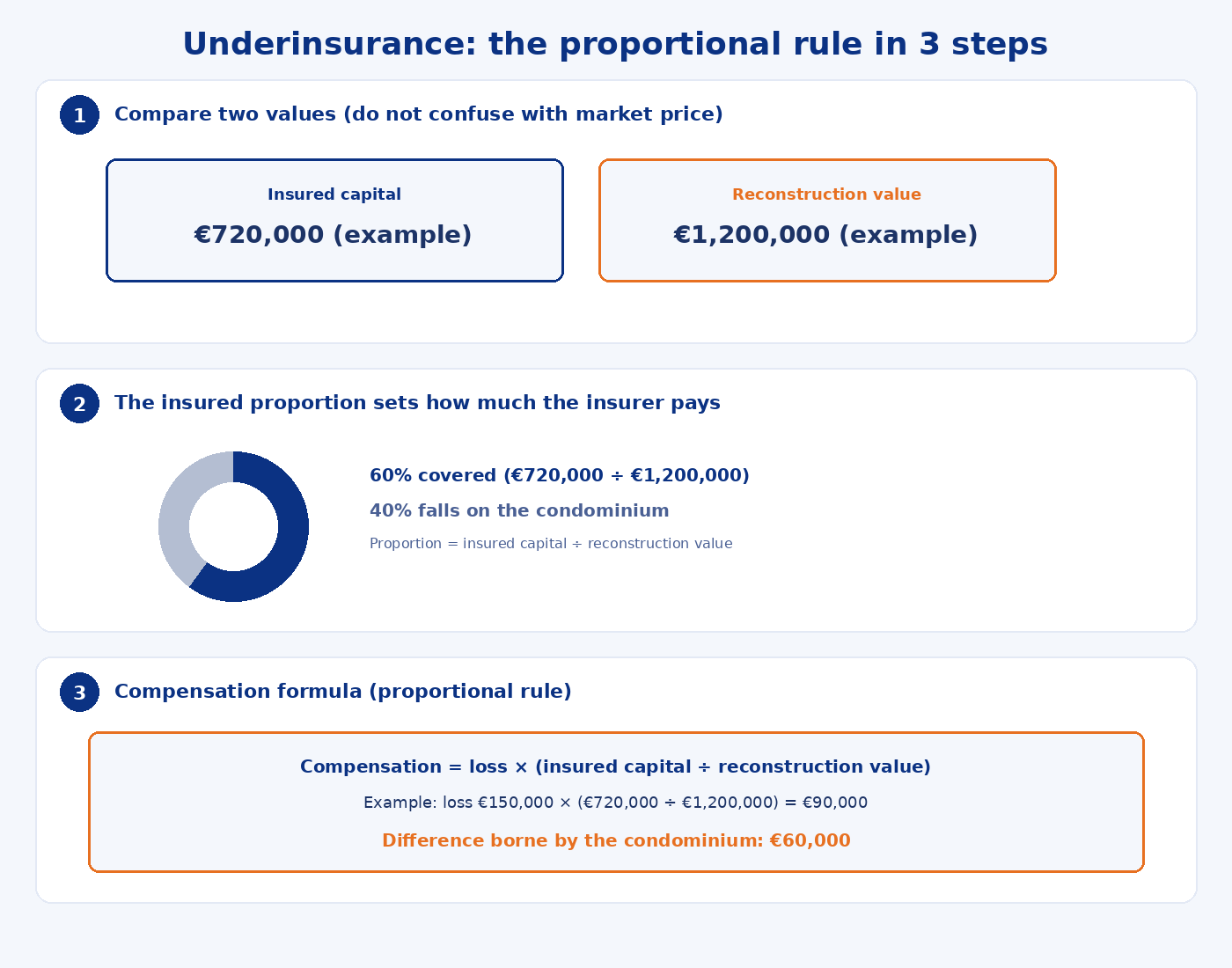
Infographic of the underinsurance proportional rule: sum insured versus reconstruction value, covered proportion and compensation formula
What underinsurance means on a building policy
Building underinsurance (underinsurance of the building policy) is the situation in which the sum insured is below the value of the insured object. For a building, that reference value is the cost of rebuilding it, not the price at which it would sell on the market. Article 134 of the Legal Regime of the Insurance Contract (approved by Decree-Law 72/2008 of 16 April) puts it in general terms:
«Unless otherwise agreed, if the sum insured is lower than the value of the insured object, the insurer is only liable for the damage in the corresponding proportion.»
In practice: if the building is insured for 60% of what it would cost to rebuild, the insurer is, as a rule, liable for about 60% of the loss (always up to the sum insured). The missing part falls on the policyholder — in a condominium, that ends up in the building budget and the service charges.
The Insurance and Pension Funds Supervisory Authority (ASF) explains the same criterion on its consumer portal: the sum relating to the property must follow the reconstruction cost, taking into account the elements of the property (except the land) and the proportional value of the common parts. The policyholder sets the sum; the insurer does not «guess» the right figure if the general meeting or the co-owner declare a low number to pay a lower premium.
The Supreme Court judgment of 1 October 2026 (and what it was not)
On 1 October 2026, the Supreme Court of Justice decided case no. 2473/24.7T8PDL.L1.S1. The full text is on DGSI. Açoriano Oriental summarised the figures: a home in Remédios da Bretanha (municipality of Ponta Delgada) was flooded on 20 August 2023; the multi-risk home sum insured was about €63,100; the Supreme Court confirmed compensation at about €36,800, plus interest.
It is essential to be clear: this was not a condominium. It was a single-family house in the Azores, with a multi-risk home policy. The underinsurance rule and the insurer’s information duty, however, are the same as those that apply to housing-risk policies — and the compulsory fire insurance for a building in horizontal property sits in the same legal framework.
The Supreme Court’s summary sets out three points the general meeting should take seriously:
«I. Underinsurance is a modifying fact, partially preventing the right to compensation. II. — Failure to comply with the communication duty in article 135(2) of the Legal Regime of the Insurance Contract is a fact that prevents that modifying fact. III. — As failure to comply with the communication duty is a fact that prevents that modifying fact, it must be pleaded by the insured.»
In plain language for a general meeting: the insurer may invoke underinsurance to reduce the payout; if it failed to inform the insured of the sum insured and the updating criteria, that blocks the reduction — but only if the insured pleads it in the proceedings. If nobody raises it on the record, the court may still apply the proportional rule. In the case decided, the first-instance court had ordered payment of the full sum insured (about €63,100); the Court of Appeal and the Supreme Court fixed about €36,800.
How the proportional rule is calculated (worked example)
The formula is simple:
Compensation ≈ loss × (sum insured ÷ reconstruction value)
| Situation | Value |
|---|---|
| Building sum insured | €720,000 |
| Estimated reconstruction value | €1,200,000 |
| Insured proportion | 60% |
| Loss from a claim (for example, roof and water) | €150,000 |
| Compensation under the proportional rule | €90,000 |
| Difference borne by the condominium | €60,000 |
In this example, even with a loss below the sum insured, compensation is not automatically €150,000: it is cut to €90,000 (60% of the loss). Some policies provide a tolerance (for example, not applying the reduction if the shortfall is 15% or less), but that depends on the contract — it is not presumed.
In the Azores case, the sum was about €63,100 and the reconstruction value was estimated at €166,100; the insurer had calculated a proportion close to 60% and proposed a lower payout; the higher court eventually fixed about €36,800. The procedural calculation details belong to that case; the lesson for the condominium is different: the proportion matters, and it is argued after the claim, when there is already pressure and an invoice.
Sum insured versus reconstruction value (and versus market price)
Three figures that general meetings often mix up:
- Market price — what a buyer would pay for the building or the unit. It includes land, location and demand.
- Rateable / tax value — used for tax; it almost never serves to size the insurance.
- Reconstruction value — what it would cost to rebuild the building to equivalent standards, excluding the land.
For building insurance, the criterion is the third. The ASF and typical fire and multi-risk policy conditions point to reconstruction cost, including incorporated elements and the share of the common parts. An «expensive» building on an avenue may have a high market value and a lower rebuild cost; an older building in an area where labour and materials have soared may have an outdated sum insured and a current rebuild cost far above it — that is where silent underinsurance appears.
What the law requires in a condominium: fire insurance and annual updating
Article 1429 of the Civil Code requires insurance against the risk of fire for the building, covering the autonomous units and the common parts. Co-owners must take it out; if they do not do so within the time and for the value set by the general meeting, the administrator takes it out and may recover the premium.
Updating is not «good practice»: it is an obligation. Decree-Law 268/94, article 5, provides that:
- Annual updating of fire-risk insurance is compulsory.
- The general meeting decides the amount of each update.
- If the general meeting does not approve the amount, the administrator must update the insurance according to the index published quarterly by the insurance supervisor (today the ASF; the text still refers to the Instituto de Seguros de Portugal, its predecessor).
For housing-risk policies, article 135 of the Legal Regime of the Insurance Contract also provides for automatic updating by the ASF indices, unless otherwise agreed, and imposes on the insurer a duty to inform the policyholder of the sum insured for total loss and of the updating criteria. Breach of that duty means the proportional rule does not apply, to the extent of the breach — with the procedural brake the Supreme Court reaffirmed in 2026: the insured must plead the lack of communication.
On the legal minimum (fire only) versus multi-risk, Condoroo has already set out the framework in Multi-risk condo insurance: the law still only requires fire cover and in the guide Condominium insurance (in Portuguese). Underinsurance applies in either form: a multi-risk policy with a low sum does not «save» the proportion.
The ASF index for the fourth quarter of 2026
Regulatory Standard 5/2026-R, approved on 18 August 2026, sets the indices for «Fire and natural elements» policies starting or renewing in the fourth quarter of 2026. The Buildings Index (IE) — the one that matters for the building — is 590.57 (base 100 in the first quarter of 1987). There are also contents indices, relevant for contents policies, not for the building sum.
The national index is a reference. The ASF itself, in the draft of the standard, recalls that policyholders must make sure of the values to insure, allowing for regional variations and changes to the insured property. Updating by the index when the starting sum was already below real cost does not fix deep underinsurance; it only stops the gap growing at the pace of construction inflation.
What to ask the insurer (and the administrator) in writing
Before the year-end general meeting — and preferably before the rainy season — the administrator or the co-owners’ committee should ask, in writing, at least for:
- The current building sum insured (and, if relevant, each material cover).
- The reconstruction value the insurer is using, if it has estimated one.
- The updating criteria applied on recent renewals (ASF index, percentage, or other).
- A copy or proof of the annual communications to the policyholder with the sum insured for total loss and the updating criteria (article 135(2)).
- Confirmation of whether the policy has a tolerance to the proportional rule (for example, an underinsurance franchise or a 15% threshold).
- A list of the exclusions that most affect the building (water, storm, vacant building, lack of maintenance).
Keep the answers in the condominium archive. If there is ever a claim and a dispute, the insurer’s lack of communication only protects the building if someone pleads it. Prior paperwork makes that plea straightforward.
For anyone renewing or comparing quotes, the guide How to take out condominium insurance (in Portuguese) helps order covers and sums before the vote.
Who pays the difference when there is underinsurance
When compensation is cut by the proportional rule, the difference does not «disappear»: someone pays for the repair. As a rule:
- Common parts / collective building policy — the condominium bears the uncovered invoice, through the budget, reserve fund or a special levy, shared by the permillage (unless a different and valid resolution says otherwise).
- Unit / individual policy — the co-owner policyholder answers for their part, without prejudice to claims against third parties responsible for the loss.
- Administrator — is not automatically liable for the underinsurance shortfall. They may be liable if they breached legal duties (for example, failing to update the fire insurance when the general meeting did not approve the amount, or failing to propose an adequate sum to the meeting under article 1436 of the Civil Code).
Condoroo, which supports more than 600 condominiums, often sees the same pattern: the meeting debates the premium to the cent and skims past the sum insured. Today’s cheaper premium is often tomorrow’s special levy.
Checklist for the general meeting before winter
Use this list in the notice of meeting or as an annex to the minutes:
- ✓Confirm there is fire insurance covering all units and the common parts (legal duty).
- ✓Ask for the current sum insured and compare it with a serious reconstruction estimate (recent quotes for roof, façade or a survey).
- ✓Resolve the amount of the annual update; if there is no agreement, record that the administrator will update by the ASF index.
- ✓Check whether the policy updates automatically by the Buildings Index and which value applies in the renewal quarter (in the fourth quarter of 2026: 590.57).
- ✓Require from the insurer, in writing, the sum insured for total loss and the updating criteria, and file the reply.
- ✓Map typical autumn and winter gaps: water, storm, gutters, roof — and whether they are covered (multi-risk) or only the fire minimum.
- ✓Decide who notifies the claim (administrator vs each policyholder) and where the policies are kept.
- ✓Avoid confusing the market price of a unit with the building sum.
- ✓If the sum is well below reconstruction, ask for quotes to increase the sum before renewing «in silence».
- ✓Record in the minutes the resolution on sum, update and who follows up.
In short for the next general meeting
Underinsurance on the building policy is not small print: it is the difference between rebuilding with the payout and passing the invoice to the co-owners. The Supreme Court judgment of 1 October 2026 reminds the meeting of two things at once — the proportional rule exists and applies; and the insurer’s information duty only blocks that rule if the insured brings it into the proceedings. In a condominium, the operational answer is to update the sum to reconstruction value, resolve the annual update (or let the administrator apply the ASF index), ask for the communications in writing, and not wait for the storm to do the sums.
Building underinsurance: frequently asked questions
What is underinsurance and how much does the insurer cut?
Underinsurance is the situation in which the sum insured is lower than the value of the insured object — for a building, the cost of rebuilding it. Under article 134 of the Legal Regime of the Insurance Contract, the insurer is liable for the damage only in the corresponding proportion, unless otherwise agreed. If the sum covers 60% of reconstruction value, as a rule it pays about 60% of the loss (up to the sum insured). The difference falls on the policyholder, as if they were themselves the insurer of that part.
How do I know whether my building’s sum insured is enough to rebuild it?
Ask the insurer (and the administrator) for the current sum insured and compare it with a serious estimate of reconstruction cost: built area, typology, materials, common equipment and current labour and materials costs in the region. Do not use the sale price of the building or the caderneta predial (property tax record) value. The Insurance and Pension Funds Supervisory Authority (ASF) confirms on its consumer portal that the property sum must follow reconstruction cost. If the gap is large, there is underinsurance.
If the general meeting does not approve the insurance update, what happens?
Annual updating of fire-risk insurance is compulsory. The general meeting decides the amount. If it does not approve, the administrator must update the insurance according to the index published quarterly by the insurance supervisor — today the ASF (Decree-Law 268/94, article 5). For policies starting or renewing in the fourth quarter of 2026, the Buildings Index is 590.57 (Regulatory Standard 5/2026-R).
Can the insurer reduce compensation if it never told me the sum insured?
For housing-risk policies, the insurer must inform the policyholder, on inception and on renewals, of the property sum insured for total loss and of the updating criteria. Breach of that duty prevents application of the proportional rule, to the extent of the breach (article 135(2) and (3)). But the Supreme Court of Justice, on 1 October 2026, made clear that the lack of communication must be pleaded by the insured in the proceedings; if nobody pleads it, the court may still apply underinsurance.
Who pays the difference: the condominium, each co-owner or the administrator?
The part of the loss not compensated because of underinsurance falls on whoever has the insured interest — as a rule the condominium (for common parts and under a collective policy) or each co-owner for their unit and their share of the common parts. The administrator does not «pay out of pocket» for the difference merely by being administrator; they are liable if they breached duties (for example, failing to update the insurance when the law requires it). Sharing among co-owners follows the permillage and what the general meeting resolves on the budget and the reserve fund.
Is the ASF index enough to avoid underinsurance?
The index stops the sum freezing against construction-cost inflation, but it does not fix a starting sum that was already too low. If the building was insured for a value far below real reconstruction cost, updating by the index keeps the disproportion. That is why the general meeting should periodically review reconstruction value with quotes or a survey, and not rely only on automatic updating.
Are the sum insured and the market price the same thing?
No. Market price includes the land, location and demand. The building insurance sum should match reconstruction cost, excluding the land. An expensive building in a central neighbourhood may have a market value well above the cost of rebuilding it — and the reverse also happens in areas where current construction has become much more expensive than the old policy sum.
This article is for information and does not replace legal advice or a reading of your building’s policy.