
 on Google


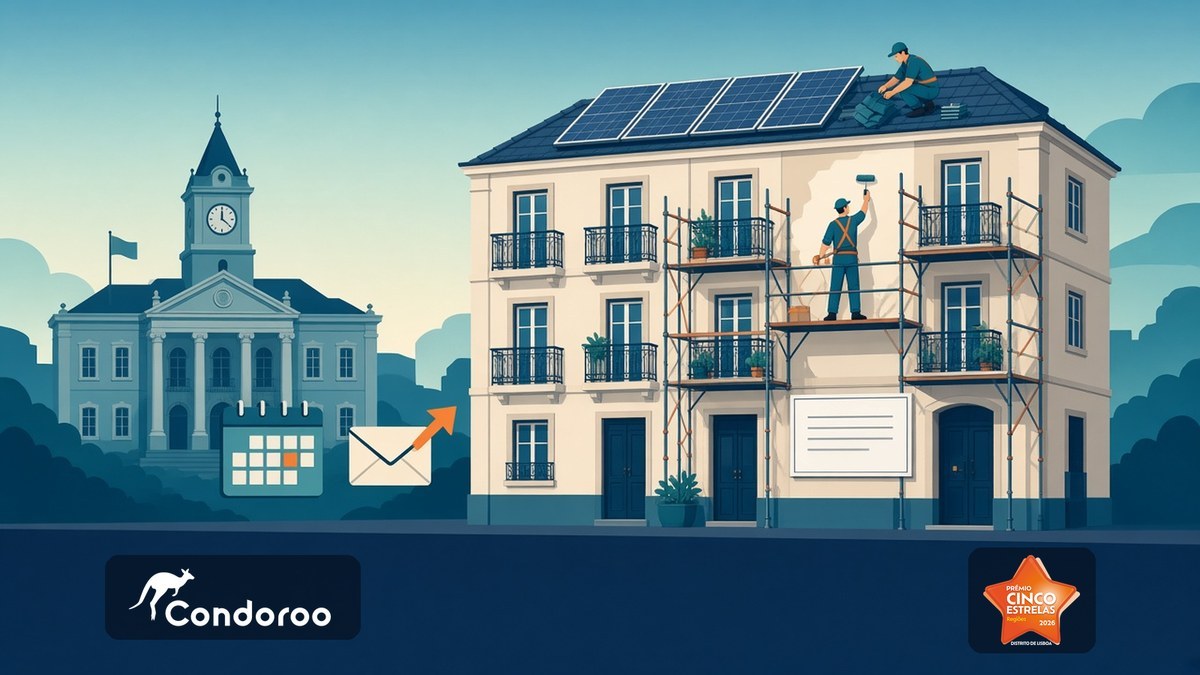
Building works in Portugal changed on 1 October 2026: under the revised RJUE (the national planning and building code), even works that need no licence, such as repainting the façade in the same colour, repairing the roof or installing solar panels, must be notified to the câmara (the town hall) at least five days before they start, with a notice posted where it can be seen from the street. Only conservation work carried out entirely indoors is exempt. Failing to notify can lead to fines starting at €500.
In short
- ✓Building works in Portugal: since 1 October 2026, even licence-exempt works must be notified to the câmara at least five days before they start.
- ✓Within the same deadline, a notice visible from the street must be posted on the building.
- ✓Only conservation work carried out entirely indoors is exempt; on a literal reading of the law, that includes repainting the hall and stairs in the same colour.
- ✓There is no exception for urgent repairs: do only the minimum needed for safety, notify straight away and keep evidence.
- ✓Failing to notify carries fines of €500 to €100,000 (individuals) or €1,500 to €250,000 (legal persons).
- ✓Notifying the câmara does not replace the decision of the owners’ meeting (assembleia de condóminos).
Guide to building works in Portugal for condominiums, updated in October 2026 with the RJUE as revised by Decree-Law 108/2026 (first published in March 2024).
Building works in Portugal: what changed on 1 October?
Decree-Law 108/2026 of 29 May revised the RJUE (Regime Jurídico da Urbanização e da Edificação), the law that sets out which works need a licence, which only need to be notified and which are exempt. It came into force on 1 October 2026, together with Ministerial Order (Portaria) 320/2026/1 of 31 July, which approves the national forms for applications, site notices and the notice of start of works. The new rules apply to procedures started from that date.
For a building held as a condomínio (a building divided into units, or frações, with shared common parts), the most practical change for building works is in article 80-A. The law now says expressly that, «including» for works exempt from a licence or prior notification, the promoter must inform the câmara of the intention to start works at least five days in advance and say who will carry them out. The same article adds three rules:
- at least five days before, a notice visible from the public road must be posted on site (no. 5);
- only conservation works carried out exclusively inside buildings or units are exempt (no. 3);
- the notice lapses if works do not start within one year (no. 6).
For building works, exempt from a licence does not mean exempt from rules. Article 6(8) points out that exempt works remain subject to municipal plans, technical standards and inspection by the câmara. The other legal changes affecting buildings this year are in our summary of condominium regulations in Portugal in 2026.
Which building works are licence-exempt but still need notice?
The version of this guide we had published since 2024 said that repairing the roof or installing solar panels did not require «authorisation from the câmara». They still need no licence, but they now need to be notified. This table sums up how the rules for building works in Portugal apply to the most common jobs in a condominium:
| Work | Licence or prior notification? | Notify the câmara 5 days before + notice? | Who approves within the condominium |
|---|---|---|---|
| Repainting the façade in the same colour | No (conservation) | Yes | Owners’ meeting, by majority of votes |
| Repairing the roof or gutters | No (conservation) | Yes | Owners’ meeting, by majority of votes |
| Replacing the roof covering with an identical, more efficient finishing material | No (minor works) | Yes | Owners’ meeting |
| Solar panels on the roof, up to 1 m above it and not beyond its area | No (minor works) | Yes | Simple majority, in buildings with at least two units (self-consumption unit, UPAC) |
| Painting the façade a different colour or changing the exterior cladding | As a rule, yes (alteration works) | Yes | Two-thirds of the building’s value |
| Painting the hall and stairs | No (conservation) | In principle, no (indoors) | Owners’ meeting, by majority of votes |
| Renovation inside a unit, without touching the façade or structure | No (interior alteration) | Yes, by the unit owner | No, unless it affects common parts |
«Conservation works», as the law defines them, are those that keep the building in its existing condition, such as restoration, repair or cleaning. «Alteration works» include changing the type and colour of exterior cladding materials. That is why the colour of the façade remains the line between exempt works and controlled works.
For solar panels, article 6-A(g) requires that they do not exceed the area of the roof or the height of the building by more than 1 m. It also allows energy storage units, provided they are hidden. The exemption does not apply to listed buildings, buildings in the process of being listed, or their protection zones.
Do the hall and stairs count as indoors?
The exception in article 80-A(3) covers conservation works «exclusively inside buildings or units». The law says «buildings», not just «units». The entrance hall, stairs and corridors are common parts of the building (article 1421 of the Civil Code) and they are indoors. On a literal reading, repainting the hall and stairs in the same colour, repairing plaster or cleaning floors does not need to be notified.
Important: two words of caution. None of the municipal sources we consulted deals with common parts expressly, so this reading has not yet been tested in practice. And the exemption covers conservation only: replacing the flooring with a different material, opening or closing openings or working on walls is interior alteration. That work is also licence-exempt, but it must be notified. If it affects stability, it also needs a structural design with a statement of responsibility, filed with the notice of start of works. If in doubt, ask the câmara to confirm in writing before you start.
What about urgent repairs?
The RJUE provides no exemption for urgent building works promoted by the condominium. The only exception to the duty to notify is indoor conservation. The rule that allows formalities to be skipped where there is an imminent risk of collapse or serious danger to public health (article 90(8)) applies to inspections by the câmara, not to works by the owner. Even works ordered by the câmara under the duty to maintain buildings must have their start notified (article 90-A(3)).
On the condominium side, the Civil Code still allows any owner to carry out essential and urgent repairs to the common parts when there is no administrator or the administrator is unable to act (article 1427). That settles who may go ahead, but it does not remove the duty to notify the câmara.
In practice, faced with a loose roof tile above the street or a serious leak, the prudent response is to limit the first intervention to what makes the site safe (fencing off, propping, removing loose elements), inform the câmara immediately and keep photos and reports that prove the urgency. If the case ever becomes an administrative offence, those records are your defence. The law does not settle this expressly, so it is worth checking with the câmara.
How do you notify the câmara, and who deals with the notice?
For building works on common parts, the promoter is the condominium, represented by its administrator, whose job is to carry out the decisions of the owners’ meeting (article 1436 of the Civil Code). The notice is given on the form in Annex II to Portaria 320/2026/1, usually through each câmara’s online services. For exempt works, point 38 of Annex V to the portaria generally asks for:
- the document proving the promoter’s standing to carry out the works;
- the identity of the person or company carrying out the works;
- a structural design and, where required, a seismic strengthening design, if an interior job touches the structure;
- proof of payment of fees, if any.
The guide from the Municipality of Vila do Bispo explains that for most exempt works the proof of standing is enough, and that files are submitted as PDF/A with a qualified digital signature. In Lisbon, the «Comunicação de início dos trabalhos» (notice of start of works) is filed through Loja Lisboa Online. For a condominium, the câmara’s document list asks for the condominium’s taxpayer card and the minutes electing the administrator. That list still cites the 2024 portaria, so check the version in force.
The notice of the building works is posted by the owner or the site manager, on site and visible from the public road, at least five days before. In Lisbon, scaffolding or skips on the street also need a separate application for use of the public road.
What is the fine for not notifying the câmara?
Article 98 of the RJUE treats failing to notify separately from failing to post the notice. Attempt and negligence are also punishable.
| Offence | Individual | Legal person |
|---|---|---|
| Starting works without notifying the câmara, or without the required documents (point c)) | €500 to €100,000 | €1,500 to €250,000 |
| Not posting the notice, or not keeping it visible from outside (point j)) | €250 to €50,000 | €1,000 to €100,000 |
Fines are imposed by the mayor and the money goes to the municipality. €250,000 is the maximum for legal persons; for an individual, the ceiling for this offence is €100,000. The law does not say which column a condominium falls into, since it is not an ordinary legal person.
What still has to go through the owners' meeting?
For building works, the RJUE governs the relationship with the câmara; decisions inside the building still follow the Civil Code. Notifying the câmara does not replace the owners’ decision, and the decision does not replace the notice.
- Conservation and ordinary repairs (roof, repainting in the same colour, gutters): a decision of the owners’ meeting by majority of votes, with a quote and the common reserve fund. See our guide to preventive roof maintenance in autumn.
- Innovations: a majority of owners representing two-thirds of the total value of the building (article 1425).
- Solar panels for self-consumption (UPAC): a simple majority, in buildings with at least two units (article 1425(3)).
- Works that change the architectural line or the look of the building, such as a new façade colour, enclosed balconies (marquises) or different window frames: prior authorisation by two-thirds of the building’s value (article 1422(3)). On balconies, read use of balconies and terraces (in Portuguese).
To approve building works without delays, the minutes must be well drafted and the notices of meeting in order. We explain how in the condominium meeting and remote voting (both in Portuguese).
Does joining or dividing units need authorisation? What we corrected
The old version said that joining units needed no authorisation «from either the câmara or the condominium». Both halves of that need fine-tuning:
- Condominium: article 1422-A of the Civil Code waives the other owners’ authorisation only for joining adjoining units (or garages and storerooms, even if they do not adjoin). Otherwise, authorisation is needed. Dividing a unit into new units is only possible if the deed of horizontal property (título constitutivo) allows it or the owners’ meeting approves it with no opposition at all. In both cases, the change to the deed must be reported to the administrator within 10 days. If the works affect common parts, such as a load-bearing wall, the owner cannot decide alone.
- Câmara: joining units changes the number of dwellings, which the law treats as alteration works. It may be licence-exempt if it is interior only and does not touch the façade, but it must always be notified. If it touches the structure, it needs a structural design. Check with the câmara whether the new layout also requires a notice of use.
Condoroo checklist before any works on the building
- ✓Classify the works: conservation, alteration, minor works or subject to a licence.
- ✓Check whether the building is listed or in a protection zone.
- ✓Approve at the owners’ meeting with the right majority and attach the quotes to the minutes.
- ✓Gather proof of standing: the condominium’s tax number (NIF) and the minutes electing the administrator.
- ✓Identify the contractor and, if there is one, the site manager.
- ✓Submit the notice of start of works at least five days in advance.
- ✓Post the notice on the building, visible from the street, within the same deadline, and photograph it.
- ✓Apply for use of the public road if there will be scaffolding or skips.
- ✓Tell the owners the dates and expected noise.
- ✓Keep receipts and photos in the building’s records.
At Condoroo, which manages more than 600 condominiums, this process for building works in Portugal is part of our construction management. With more than 35 inspections a day (in Portuguese) and more than 20 professionals, problems are spotted early and works go into the calendar with room for the five days. Records are kept in the digital building logbook.
Conclusion
Building works in Portugal, in short: until 30 September, many condominiums assumed that «exempt works» meant works without paperwork. Since 1 October, the opposite is true: almost everything done on the outside of the building, from the roof to the façade and the panels, is notified to the câmara five days in advance and announced with a notice on the street. Only indoor conservation escapes. This autumn, before the roof repair, add the notice to the câmara and the posted site notice to the approval of the works.
Building works in Portugal: frequently asked questions
Do I need permission from the câmara to repaint the building's façade?
If it is the same colour, no licence is needed, because it is conservation work. Since 1 October 2026, you must inform the câmara at least five days before works start and post a notice visible from the street. Changing the colour is alteration work and also needs two-thirds of the building’s value at the owners’ meeting.
Does a condominium roof repair have to be notified to the câmara?
Yes. Repairing the roof is exterior conservation work, exempt from a licence but not from the notice of start of works (article 80-A of the RJUE). The condominium, through its administrator, notifies at least five days in advance and posts the notice on site.
Which building works in Portugal are exempt from notifying the câmara?
Only conservation works carried out exclusively inside buildings or units, such as painting interior walls or repairing plaster. Interior alteration works, such as changing the layout of rooms, remain licence-exempt but must be notified.
Does painting the building's hall and stairs have to be notified?
On a literal reading of the law, no: the exception covers conservation «inside buildings», and the hall and stairs are indoor common parts. No municipal source confirms this expressly, so if in doubt, ask the câmara to confirm.
Can an urgent repair start without telling the câmara?
The RJUE has no exception for urgent works by a condominium. The prudent course is to limit the first intervention to what makes the site safe, inform the câmara immediately and keep evidence of the urgency, such as photos and reports.
What is the fine for not notifying the start of works?
Between €500 and €100,000 for individuals and between €1,500 and €250,000 for legal persons. Not posting the notice carries a fine of €250 to €50,000, or €1,000 to €100,000. Negligence is also punishable.
Does joining two units need the condominium's authorisation?
No, if the units adjoin or are garages and storerooms (article 1422-A of the Civil Code). It does if they do not adjoin or if the works affect common parts. Dividing a unit needs authorisation in the deed or a decision with no opposition. The works must always be notified to the câmara.