 on Google


When is IMI paid? The Municipal Property Tax (Imposto Municipal sobre Imóveis, IMI) is paid in the year after ownership: in May, August and November, depending on the amount. In October and November 2026 the last instalment of 2025 IMI is due; in 2027 you pay 2026 IMI in the same months. Anyone who misses an instalment sees the rest fall due at once and accrues late-payment interest. This guide explains the calendar, rates in the municipalities where Condoroo operates, exemptions and what to do if you are late.
In short
- ✓IMI for a given year is paid the following year, in May, August and November, depending on the amount (article 120 of the Municipal Property Tax Code).
- ✓Up to €100: one instalment in May. Over €100 and up to €500: May and November. Over €500: May, August and November.
- ✓In November 2026 the last instalment of 2025 IMI is due (for anyone paying in two or three instalments). In 2027 you pay 2026 IMI.
- ✓You may pay the full amount in one go in May; the collection notice includes the reference for the full amount.
- ✓If you miss an instalment, the remaining ones fall due immediately; late-payment interest applies and, without regularisation, enforced tax collection.
- ✓The rate is set by each municipality (between 0.30% and 0.45% for urban property). Always confirm yours on the Portal das Finanças (Tax Authority portal).
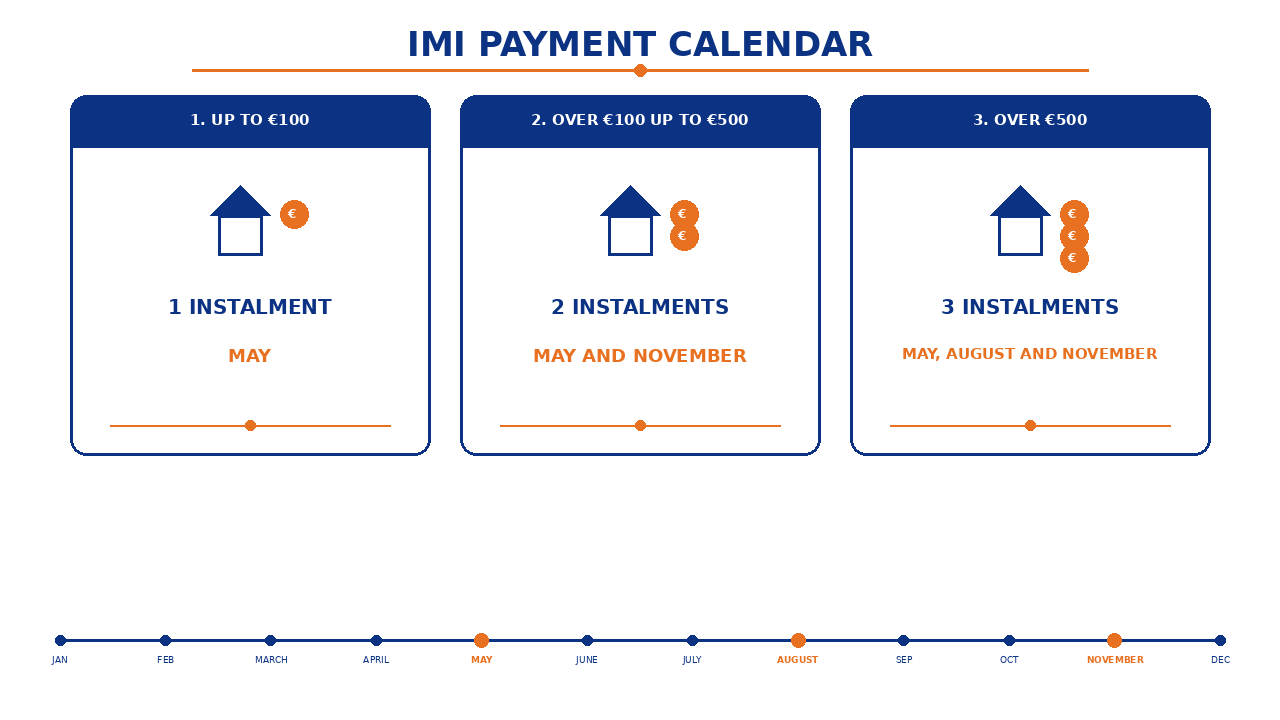
Infographic of the IMI payment calendar: one, two or three instalments in May, August and November depending on the amount
What IMI is and who pays it
The Municipal Property Tax (IMI) is the annual tax on the tax value (valor patrimonial tributário, VPT) of properties, collected by the Tax and Customs Authority (Autoridade Tributária e Aduaneira, AT) for the municipality where the property sits. Taxable persons are the owners, usufructuaries or surface-right holders recorded on the property registers on 31 December of the year to which the tax relates — that is, whoever held the property in their name at the end of the year before payment.
The basic formula is simple: IMI = VPT × municipal rate. The VPT is on the caderneta predial (property tax record) and on the collection notice. Urban property rates usually sit between 0.30% and 0.45% (they can reach 0.5% in municipalities under an adjustment programme). Rural property pays 0.8% nationwide. There are surcharges (for example, vacant property) and reductions (rehabilitation, letting, families with dependants), which Condoroo has already covered in IMI on vacant property and in the guides to support for condominiums in Lisbon and in Porto (in Portuguese).
When is IMI paid: the calendar by amount
Article 120 of the Municipal Property Tax Code (CIMI) sets the number of instalments by amount:
«1 — The tax must be paid: a) In one instalment, in the month of May, when its amount is equal to or less than (euro) 100; b) In two instalments, in the months of May and November, when its amount is more than (euro) 100 and equal to or less than (euro) 500; c) In three instalments, in the months of May, August and November, when its amount is more than (euro) 500.»
| IMI amount | Instalments | Months |
|---|---|---|
| Equal to or less than €100 | 1 | May |
| More than €100 and equal to or less than €500 | 2 | May and November |
| More than €500 | 3 | May, August and November |
The law speaks of months, not specific days. The last working day of each month (and the AT tax calendar when the month ends on a weekend or holiday) sets the practical deadline. In the AT 2026 tax calendar, the May IMI instalment moved to 1 June (because 31 May was a Sunday), August stayed on 31 August and November on 30 November. In 2027, 31 May, 31 August and 30 November are working days.
Anyone who prefers may pay the full amount in one go in May: the collection notice includes the reference for full payment. gov.pt confirms this calendar and states that the letter with the amount and payment details is sent by 30 April, by post or electronic notification.
What is due now (November 2026) and what comes in 2027
In October and November 2026, anyone with 2025 IMI over €100 still has the November instalment to pay. Anyone who already paid everything in May has nothing further to do on this tax until 2027.
In 2027 you pay 2026 IMI (properties in your name on 31 December 2026):
- Single instalment or 1st instalment: May 2027
- 2nd instalment (only if IMI is over €500): August 2027
- Last instalment (two or three instalments): November 2027
The 2026 IMI rates (those applied to the tax paid in 2027) are approved by municipal assemblies and notified to the AT by 31 December 2026. In January 2027, check on the Portal das Finanças whether your municipality changed the rate.
How and where to pay (including direct debit)
According to the Portal das Finanças and gov.pt, IMI can be paid:
- On the Portal das Finanças (home banking / Multibanco reference)
- At Multibanco ATMs
- At CTT counters
- At bank counters with an AT protocol
- At collection desks of local Tax Offices
- By direct debit, after signing up on the Portal das Finanças or at a local Tax Office
To view the collection notice: sign in to the Portal das Finanças, go to Properties (or Municipal Property Tax) > Consult Collection Notices and select the year. Keep the Single Collection Document (DUC) and the reference. If you use direct debit, confirm that the mandate covers IMI and that the account has funds on collection days — a rejected debit does not «postpone» the deadline.
Worked example: the same home in Lisbon, Porto and Oeiras
Imagine a couple with two dependants, owner-occupied permanent home, with a VPT of €120,000. We use the 2025 IMI rates (charged in 2026), from the AT consultation reproduced in public sources on 14 October 2026. The family IMI deduction (article 112-A of the CIMI) is €70 for two dependants, when the municipality applies it.
| Municipality | Rate (2025 IMI / paid in 2026) | Family IMI | Calculation | IMI due | Instalments |
|---|---|---|---|---|---|
| Lisbon | 0.30% | Yes (€70) | €360 − €70 | €290 | May and November |
| Porto | 0.324% | No | €388.80 | €388.80 | May and November |
| Oeiras | 0.45% | Yes (€70) | €540 − €70 | €470 | May and November |
The gap between Lisbon and Oeiras, with the same VPT and the same family, is €180 a year. In Porto the rate is close to Lisbon’s, but the absence of family IMI means the family pays about €99 more than they would in Lisbon. In all these examples the tax sits between €100 and €500: two instalments.
IMI rates in the main Condoroo municipalities (2025 IMI, paid in 2026)
Always confirm your property’s rate on the Portal das Finanças — consult IMI rates. The table below summarises the most cited values for urban properties assessed under the CIMI, with an indication of family IMI. The 2026 IMI rates (paid in 2027) may change by 31 December 2026.
| Municipality | Urban property rate | Family IMI |
|---|---|---|
| Lisbon | 0.30% | Yes |
| Amadora | 0.30% | Yes |
| Sintra | 0.30% | No |
| Cascais | 0.35% | Yes |
| Oeiras | 0.45% | Yes |
| Loures | 0.361% | Yes |
| Odivelas | 0.33% | Only from 2 dependants |
| Vila Franca de Xira | 0.30% | Yes |
| Almada | 0.35% | Only from 3 dependants |
| Seixal | 0.325% | No |
| Barreiro | 0.35% | No |
| Montijo | 0.31% | Yes |
| Setúbal | 0.37% | Yes |
| Porto | 0.324% | No |
| Gaia | 0.36% | Only from 3 dependants |
| Matosinhos | 0.37% | Yes |
| Maia | 0.345% | Only from 3 dependants |
| Valongo | 0.34% | Yes |
| Funchal | 0.30% | Yes |
For local support (urban rehabilitation areas, rate reductions, VAT on works), see the article for your municipality in the Support for condominiums series (in Portuguese) — for example Lisbon, Porto, Amadora, Cascais and Sintra.
Family IMI: the deduction for dependants
Article 112-A of the CIMI lets municipalities reduce IMI on the owner-occupied permanent home according to the number of dependants in the household (composition on 31 December of the year before the tax):
| Dependants | Fixed deduction |
|---|---|
| 1 | €30 |
| 2 | €70 |
| 3 or more | €140 |
The Tax Authority applies the deduction automatically, based on the registers, the taxpayer register and IRS returns — you do not need to apply, provided the municipality has opted in and the home is the owner-occupied permanent residence with tax domicile there. If the deduction does not appear on the notice, check the household and domicile on the Portal das Finanças. Not every municipality opts in: Porto, Sintra, Seixal and Barreiro are among those that, on the 2026 consultation, do not apply the deduction.
Exemptions: owner-occupied home, low income and rehabilitation
There are several exemptions and special regimes. The thresholds move with the Social Support Index (Indexante dos Apoios Sociais, IAS) — in 2026 the IAS is €537.13 (Ordinance 480-A/2025/1).
Low-income exemption (article 11-A of the CIMI). As a rule, rural properties and the urban owner-occupied permanent home of the household are exempt when the household’s total gross income does not exceed 2.3 times the value of 14 IAS and the overall VPT of the household’s properties does not exceed 10 times the value of 14 IAS. gov.pt (updated on 2 September 2026) indicates, for 2026, annual gross income up to €17,295.59 and a VPT up to €66,500 for the permanent exemption linked to these criteria — always confirm the current figures on the Portal das Finanças, because the legal indexation can vary.
Temporary exemption on owner-occupied permanent home (new property / purchase). gov.pt refers to a VPT up to €125,000, household annual income up to €153,000, a maximum duration of three years (with a possible two-year extension by municipal resolution) and a lifetime limit of two applications per taxpayer or household. Anyone with debts to the State generally cannot apply for this temporary exemption.
Urban rehabilitation and other municipal reductions. Many municipalities reduce or exempt IMI in urban rehabilitation areas (ARU) and may reduce the rate on let properties. Local detail is in Condoroo’s support articles by municipality. The Lisbon IMI reduction for affordable letting is being prepared in another Condoroo article: when it is published, this text will link to it.
Check active exemptions under Properties > Exemptions on the Portal das Finanças.
What happens if you miss a payment
Three important consequences:
- Immediate due date of the remaining instalments. Article 120(4) of the CIMI provides that failure to pay an instalment on time makes the remaining ones fall due at once. If you miss May and have further instalments, the rest of the tax becomes payable immediately.
- Late-payment interest. Article 121 of the CIMI refers to article 44 of the General Tax Law: late-payment interest is due when the tax is not paid by the deadline on the collection document.
- Enforced tax collection. Without regularisation, the debt enters coercive collection. On the Portal das Finanças you can consult «Debts in Enforced Collection», issue a payment document and, in some cases, ask to pay in instalments. gov.pt also mentions a possible fine under article 116 of the General Regime of Tax Offences — the most immediate practical effect of late IMI payment, however, is interest and enforcement.
To regularise: pay as soon as possible with the updated reference on the Portal; if enforcement has already started, use the debts area and, if needed, ask for help at a Tax Office. Do not ignore the notice: the cost rises with time.
Owner checklist before each instalment
- ✓Confirm on the Portal das Finanças the collection notice for the year and the amount of each instalment.
- ✓Check that direct debit is active and that the account has funds.
- ✓Confirm the municipal rate and whether family IMI or an exemption applies.
- ✓Keep the payment proof (PDF or statement).
- ✓If you changed address or tax domicile, update the data before the next assessment.
- ✓If you bought or sold the property mid-year, remember: whoever is on the register on 31 December answers for that year’s IMI (adjustments between parties are settled in the sale contract).
- ✓For vacant or closed properties, review the risk of an IMI surcharge (see the Condoroo article on vacant property).
- ✓In November, anyone paying in two or three instalments: mark the last day of the month in the calendar.
In short for the next deadline
IMI does not surprise anyone who knows the calendar: May, August and November, with the number of instalments depending on the amount. In November 2026, 2025 IMI closes; in 2027 the 2026 IMI cycle opens. Pay on time, set up direct debit if it helps, confirm the rate and exemptions on the Portal das Finanças, and deal with any delay now — interest and acceleration of the remaining instalments cost more than the missed instalment.
When is IMI paid: frequently asked questions
When is IMI paid in 2026 and in 2027?
IMI for a given year is paid the following year. In 2026 you pay 2025 IMI: in May (and, depending on the amount, also in August and November). In November 2026 the last instalment is due for anyone paying in two or three instalments. In 2027 you pay 2026 IMI in the same months. The thresholds are: up to €100, May only; over €100 and up to €500, May and November; over €500, May, August and November (article 120 of the CIMI).
In how many instalments is IMI paid?
It depends on the total tax amount. Equal to or less than €100: one instalment in May. More than €100 and equal to or less than €500: two instalments, in May and November. More than €500: three instalments, in May, August and November. You may always pay the full amount in one go in May, using the full-payment reference on the collection notice.
What happens if I do not pay an IMI instalment on time?
Failure to pay an instalment on time makes the remaining ones fall due immediately (article 120(4) of the CIMI). Late-payment interest is due under article 121 of the CIMI and article 44 of the General Tax Law. Without regularisation, the debt may enter enforced tax collection. Regularise on the Portal das Finanças as soon as possible.
How do I set up direct debit for IMI?
Sign up on the Portal das Finanças or at a local Tax Office. Once active, confirm that it covers IMI and that the account has funds on collection days. A rejected debit does not postpone the legal payment deadline.
What is family IMI and do I have to apply for it?
It is a fixed deduction on IMI for the owner-occupied permanent home, according to the number of dependants: €30 (1), €70 (2) or €140 (3 or more), if the municipality has opted in (article 112-A of the CIMI). The Tax Authority applies it automatically; you do not need to apply. If it does not appear on the notice, check the household and tax domicile on the Portal das Finanças. Not every municipality opts in.
Who is exempt from IMI?
There is a low-income exemption (article 11-A of the CIMI), a temporary exemption on owner-occupied permanent homes under VPT and income conditions, and municipal urban-rehabilitation regimes, among others. The 2026 thresholds on gov.pt point, for the permanent low-income exemption, to annual gross income up to about €17,295.59 and a VPT up to €66,500 — always confirm on the Portal das Finanças. Check Properties > Exemptions in your authenticated area.
Is the IMI rate the same nationwide?
No. Each municipality sets the urban property rate between 0.30% and 0.45% (article 112 of the CIMI). Rural property pays 0.8% nationwide. The rate that counts is that of the municipality where the property sits, not your tax domicile (except for family IMI, which requires an owner-occupied permanent home with tax domicile at the property). Confirm the rate on the Portal das Finanças.